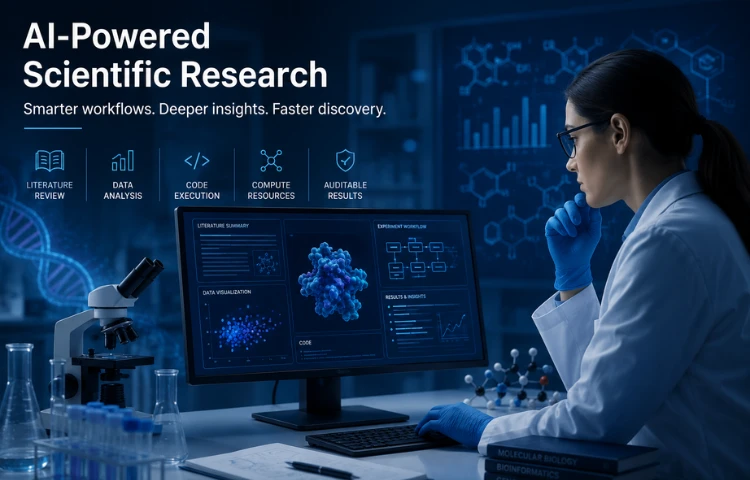
Artificial intelligence is no longer just helping us draft emails, summarize meetings, or generate code. It is stepping into one of humanity’s most important arenas: scientific discovery. With the launch of Claude Science, Anthropic is positioning its AI assistant as a powerful research workbench built for scientists, biotech teams, pharmaceutical companies, and research-driven organizations.
Unlike a standard chatbot, Claude Science is designed to support complex scientific workflows, from analyzing data and reviewing literature to generating reproducible outputs and assisting with research documentation. For industries where accuracy, auditability, and trust are non-negotiable, this launch signals a major shift in how AI could accelerate discovery while keeping human expertise at the center.
What Is Claude Science?
Claude Science is not just “Claude, but wearing a lab coat.” It is a specialized research environment built around the messy reality of modern scientific work. Researchers often jump between literature databases, Jupyter notebooks, R scripts, high-performance computing systems, genomics tools, molecular viewers, spreadsheets, manuscripts, and collaboration platforms. Every tool has its own format, interface, quirks, and occasional personality disorder.
Claude Science attempts to bring these pieces together.
Reuters describes the platform as an AI research workbench built to help scientists streamline research, analyze data, and manage complex computing workflows. You can read their coverage here: [Reuters]
The key feature is not simply automation. It is traceability. Anthropic says Claude Science produces auditable artifacts, meaning researchers can inspect how a figure, analysis, or manuscript section was created. For science, that is a big deal. A clever AI answer is nice. A reproducible workflow with sources, code, context, and validation history is much better.
Why This Is a Big Shift for Scientific Research
Science is not slow because scientists are slow. Science is slow because the process is complex. Literature reviews can involve thousands of papers. Genomics analysis can require specialized pipelines. Protein modeling and molecular analysis can demand serious compute. Clinical and biomedical research must also operate within strict regulatory and ethical boundaries.
Claude Science is interesting because it targets the workflow layer. It is not claiming to replace scientists. Instead, it is trying to reduce the operational drag around research: searching literature, preparing analyses, building figures, checking citations, managing compute, and turning results into structured outputs.
The Most Important Feature: Auditability
For scientific users, auditability may be Claude Science’s strongest selling point. AI systems are often criticized for producing confident answers without enough transparency. In research, that is a nonstarter. If a tool helps generate a figure, analyze a dataset, or summarize a paper, researchers need to know where the output came from and whether it can be reproduced.
Anthropic says Claude Science includes the code, environment, plain-language explanation, and message history behind generated outputs. It also includes a reviewer agent that can check citations, calculations, and whether figures match their underlying code.
Why Pharma and Biotech Should Pay Attention
Claude Science lands at a moment when pharma, biotech, and healthcare organizations are aggressively exploring AI to improve research and development. Anthropic has already been building in this direction through Claude for healthcare and life sciences. Its earlier update [Anthropic] highlighted connectors for PubMed, ClinicalTrials.gov, ChEMBL, Open Targets, Medidata, bioRxiv, medRxiv, and other scientific resources.
Claude Science pushes that strategy further. It focuses on practical research execution: single-cell analysis, CRISPR screen design, protein structure prediction, cheminformatics, manuscript drafting, and computational workflows.
What Makes Claude Science Different From a General AI Assistant?
A general AI assistant can summarize a paper or help write Python code. Claude Science is aiming for something more integrated: a workspace where AI can interact with research tools, scientific databases, code, compute resources, and domain-specific workflows.
That makes it closer to an operating layer for AI-assisted science.
Anthropic says Claude Science can work locally on macOS or Linux, connect to remote machines over SSH, and support high-performance computing workflows. It is also preconfigured with scientific connectors and skills across areas like genomics, proteomics, structural biology, single-cell analysis, and cheminformatics.
That matters because scientists do not need a generic answer machine. They need a tool that understands the shape of their work.
The Bigger Picture: AI Workbenches Are the New Enterprise Battleground
Claude Science also signals a broader enterprise AI shift. AI companies are no longer competing only on chatbot quality. They are competing on specialized workbenches for professional domains: law, finance, coding, healthcare, life sciences, and research.
This is the future of AI adoption: not one model to rule them all, but specialized interfaces and governed workflows for high-value tasks.
For organizations building their own AI strategies, the lesson is clear. Do not start with “Which model should we buy?” Start with: “Which workflow creates measurable value, and how do we make it safe, auditable, and useful?”
Final Takeaway
Anthropic Claude Science is important because it represents a more mature vision for AI in research. It is not just about faster answers. It is about faster, better-documented, more reproducible scientific workflows.
For scientists, it could reduce tool fragmentation and speed up analysis. For pharma and biotech teams, it could make research pipelines more efficient. For compliance and governance leaders, it raises the bar for auditability and responsible deployment. And for the broader AI market, it shows where things are headed: domain-specific AI workbenches that help professionals do real work, not just admire impressive demos.
The lab bench is getting an AI upgrade. The trick now is making sure the science stays rigorous, the workflows stay transparent, and the humans stay firmly in charge.