The robotics industry just got a very practical plot twist. Robot.com, the company formerly known for campus and sidewalk delivery robots under the Kiwibot name, is now betting its next act on workplace humanoids. Instead of trying to build a shiny sci-fi robot butler for every home, Robot.com is focusing on something far more commercially grounded: robots that help businesses complete repetitive, physically demanding tasks in kitchens, logistics facilities, healthcare environments, hospitality spaces, and other labor-intensive workplaces.
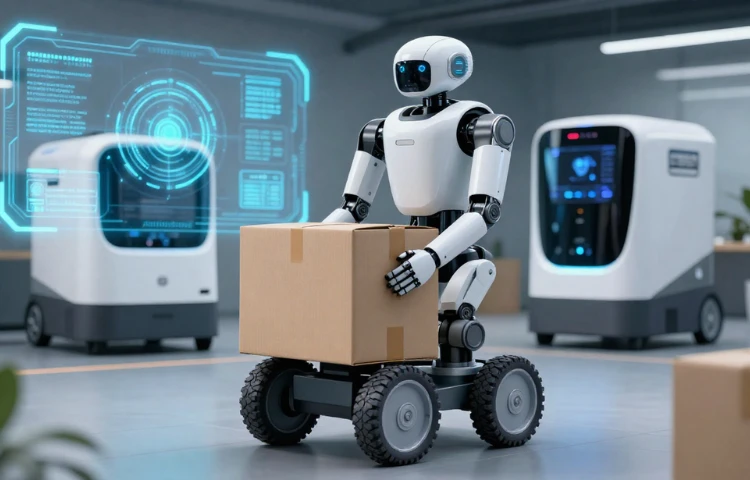
According to recent reporting from Business Insider, Robot.com is launching a wheeled humanoid called R-noid, designed to handle work such as packaging orders, manipulating boxes, preparing workstations, folding linens, picking items, and assisting in restaurant operations. The company has already deployed fewer than 40 R-noids across roughly a dozen customers and is positioning the robot as a practical workplace assistant rather than a broad consumer gadget. [Business Insider]
From Delivery Bots to Workplace Humanoids
Robot.com’s shift makes sense because the company is not starting from zero. Its earlier delivery robot fleet reportedly included around 500 robots that completed millions of real-world tasks, giving the startup something many robotics companies desperately need: field experience. Business Insider reports that Robot.com has completed about 2.5 million tasks through its robot operations, a useful foundation for moving from outdoor delivery into controlled workplace environments.
That real-world experience matters. Robotics is not just about hardware; it is about reliability, operations, maintenance, human oversight, customer workflows, and edge cases. A delivery robot that navigates sidewalks teaches a company plenty about autonomy, fleet management, remote support, safety, and customer expectations. R-noid now applies that operational muscle to indoor work, where repetitive tasks are easier to define and measure.
Robot.com’s own site describes R-noid as a humanoid robot built for “job-ready roles” across kitchens, packing lines, order picking, and linen folding. The company also says its platform can be deployed on a customer’s floor in weeks, which is a bold claim in a robotics market where pilots often move at the speed of frozen molasses.
Why Workplace Humanoids Are Having a Moment
The timing is not random. The broader robotics market is moving away from single-purpose automation and toward robots that can handle multiple tasks in human-designed environments. The big idea is simple: most workplaces were built for human bodies, human hands, and human movement. A humanoid or semi-humanoid robot can theoretically use the same counters, shelves, carts, tools, and workflows without requiring companies to rebuild the entire facility.
Robot.com is not alone in this direction. Recent coverage from Reuters and The Verge highlights how Genesis AI is developing Eno, a robot that uses a wheeled base and human-like hands while prioritizing function over human appearance. This trend suggests that “humanoid” may increasingly mean “human-capable” rather than “human-looking.” Wheels may win over legs in many commercial settings because flat floors, kitchens, warehouses, and hospitals do not usually require parkour. Thank goodness. [Reuters]
The software side is evolving just as quickly. Physical Intelligence, Robot.com’s AI partner, has published research on robotic foundation models designed to help robots generalize across tasks, environments, and embodiments. Its π0.7 model research describes language-following, cross-embodiment generalization, and the ability to perform complex manipulation tasks with broader adaptability than traditional task-specific systems.
What R-noid Is Designed to Do
R-noid appears to be aimed at businesses that need help with repetitive, high-turnover, operationally annoying work. That includes packing, sorting, folding, workstation prep, restaurant support, and basic material handling. These are not glamorous jobs, but they are exactly the kinds of workflows where automation can create measurable value.
Business Insider reports that R-noid integration takes around 8 to 12 weeks and includes task identification, data collection, model calibration, and remote support. The same report notes that the robot currently starts with about 70% autonomy, which means humans are still part of the process. That is important: this is not “set it and forget it” automation. It is more like “deploy, supervise, improve, repeat.”
That model may actually be more realistic for businesses. A robot that can do 70% of repetitive work reliably, while escalating the remaining edge cases to human operators, can still reduce workload pressure and improve consistency. It also gives companies a gradual path into robotics instead of forcing an all-or-nothing transformation.
The Business Case: Less Hype, More Workflow
For restaurants, warehouses, healthcare facilities, and hospitality operators, the value of workplace humanoids is not about replacing people in a dramatic movie-trailer way. It is about reducing bottlenecks. A robot that folds linens, carries items, packs boxes, or preps a station can free staff to focus on customer service, care delivery, quality control, and exception handling.
This is where Robot.com’s strategy gets interesting. The company is not pitching R-noid as a general-purpose dream machine. It is packaging the robot around defined roles, which makes the sales conversation easier. A business does not want to buy “a humanoid.” A business wants fewer delayed orders, smoother kitchen operations, faster packaging, lower injury risk, and better staff retention.
The strongest robotics companies may be the ones that sell outcomes, not robots. Nobody wakes up excited to procure “embodied AI infrastructure.” They wake up wanting the lunch rush to be less chaotic.
The Labor Question: Assistance, Replacement, or Reconfiguration?
No serious conversation about workplace humanoids can ignore labor impact. Automation changes jobs. Sometimes it removes tasks; sometimes it creates new ones; often it reshapes the work around human supervision, maintenance, training, and exception handling.
A recent Wired report on humanoid robot training in Shenzhen shows how teleoperation and robot supervision are already becoming emerging job categories. Workers use VR headsets, motion-tracking suits, and controllers to operate humanoid robots while generating training data that can improve future autonomy. [WIRED]
That matters because Robot.com’s 70% autonomy figure points to a hybrid future. In the near term, many workplace humanoids will need humans in the loop. Companies adopting them should plan for new roles such as robot operations lead, workflow trainer, safety monitor, maintenance coordinator, and automation analyst.
Ethically, the best deployments will be transparent with workers, focused on safety, and paired with reskilling. Robots should reduce repetitive strain and tedious work without turning employees into invisible babysitters for machines. The goal should be better jobs, not just fewer people.
Safety, Governance, and Regulation Will Decide the Winners
Workplace humanoids bring new responsibilities. These machines operate near people, touch objects, move through shared spaces, and may use cameras or sensors to perceive the environment. That raises important questions about workplace safety, privacy, data retention, accountability, and failure response.
Businesses considering R-noid or similar systems should ask practical questions before deployment: What data does the robot collect? Who can access it? How are incidents logged? Can the robot stop safely around humans? How are workers trained? What happens when the robot encounters an unfamiliar object or unsafe condition?
Research on delivery robots also shows that public-facing and workplace robots are not purely technical systems. They depend on human cooperation, spatial norms, policy, and support labor. A 2026 paper on delivery robots argues that robot labor often reconfigures labor rather than simply replacing it, because automation relies on people, institutions, and social accommodations around the robot.
What This Means for Business Leaders
Robot.com’s pivot signals a broader shift in robotics: the market is moving from “look what robots might do someday” to “what job can this robot do by next quarter?” That is a healthier, more useful framing.
For business leaders, the key is to start with workflows rather than hardware. Identify repetitive, measurable tasks with high turnover, ergonomic risk, or frequent delays. Then assess whether a robot can perform those tasks safely and consistently within existing operations. The most successful early adopters will not be the companies that buy the flashiest humanoid. They will be the ones that redesign workflows thoughtfully around human-robot collaboration.
Final Takeaway
Robot.com’s workplace humanoid bet is compelling because it is practical. R-noid is not trying to be your coworker, your concierge, your chef, and your emotional support toaster all at once. It is designed to take on specific repetitive jobs where businesses can measure value.
That grounded approach may be exactly what humanoid robotics needs. The future of workplace automation will not arrive as one giant leap into general-purpose robot labor. It will arrive task by task, pilot by pilot, workflow by workflow. Robot.com’s next act is worth watching because it represents the new robotics playbook: fewer moonshots, more useful machines.