Nvidia CEO Jensen Huang has made a bold statement about the future of artificial intelligence: Taiwan is not just part of the AI supply chain—it is the “epicentre” of the AI revolution. Speaking in Taipei, Huang said Nvidia’s annual spending in Taiwan has grown from roughly $10–15 billion a year several years ago to about $100 billion, with plans to reach $150 billion a year. The announcement came during a launch celebration for Nvidia’s planned Taiwan headquarters, which is expected to break ground in 2026 and become operational by 2030. [Moneycontrol]
That number is enormous, but the bigger story is strategic. Nvidia is doubling down on the place where many of the world’s most advanced AI chips, servers, and high-performance computing systems are physically made. Taiwan sits at the center of a dense technology ecosystem that includes TSMC, Foxconn, Wistron, Quanta Computer, and other manufacturing partners that help turn AI chip designs into deployable infrastructure. [Reuters]
Why Taiwan Matters So Much to Nvidia
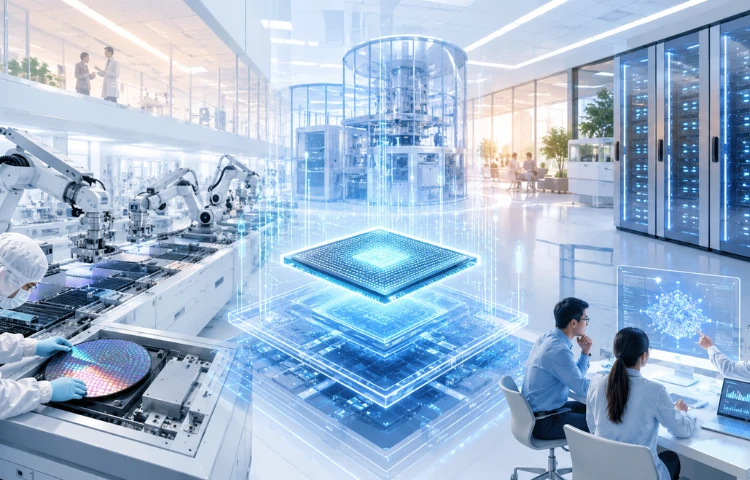
AI may feel like software magic, but behind every chatbot, coding assistant, robotics model, and enterprise AI platform is a physical stack: GPUs, CPUs, advanced packaging, memory, networking, servers, cooling systems, and data centers. Taiwan is where many of those pieces come together.
TSMC is especially important because it manufactures many of the advanced semiconductors used in AI systems. Nvidia’s planned Taiwan headquarters brings the company closer to TSMC and the broader manufacturing network that supports AI infrastructure at scale. That proximity matters because modern AI hardware is not just about chip design; it is about rapid iteration across manufacturing, packaging, server design, and deployment.
This is also why Nvidia’s Taiwan move should be viewed less like a traditional office expansion and more like an AI infrastructure strategy. Nvidia’s Blackwell architecture, for example, is designed for large-scale “AI factories”—data-center-scale systems built to train, fine-tune, and run advanced AI models. Nvidia describes Blackwell as the engine behind AI factories, with systems such as GB200 NVL72 built for real-time inference on trillion-parameter models.
The Rise of the AI Factory
The phrase “AI factory” is more than marketing sparkle dust. It describes a new kind of industrial infrastructure where data goes in and intelligence comes out. Instead of producing cars, steel, or consumer electronics, these factories produce model outputs, automation, recommendations, simulations, and decisions.
Nvidia has been pushing this concept aggressively. Its AI factory framework includes accelerated computing, networking, full-stack software, and data-center-scale orchestration. In practical terms, this means companies are no longer buying isolated chips; they are building entire AI production environments.
Taiwan’s role becomes critical because AI factories require massive coordination across hardware supply chains. Foxconn, for instance, is working with Nvidia and Taiwan’s government to build an AI factory supercomputer featuring 10,000 Nvidia Blackwell GPUs, designed to expand AI computing access for researchers, startups, and industries. TSMC is also expected to use that cloud AI infrastructure for research and development.
Why $150 Billion a Year Is a Signal to the Market
Nvidia’s projected $150 billion annual Taiwan spending signals three things.
First, AI demand is still scaling fast. The world’s biggest cloud providers, AI labs, enterprises, and governments are racing to secure compute capacity. That demand flows directly into GPUs, AI servers, advanced packaging, and data center infrastructure.
Second, supply chain control is becoming a competitive advantage. Nvidia’s success depends not only on designing powerful chips but also on ensuring they can be manufactured and delivered at huge volumes. Taiwan gives Nvidia access to the partners and production expertise needed to keep pace.
Third, AI infrastructure is becoming geopolitical. Taiwan’s centrality to the semiconductor supply chain makes it strategically vital, but also exposed to geopolitical risk. Nvidia’s decision to increase spending there shows confidence in Taiwan’s long-term importance, while also highlighting why governments and enterprises are paying closer attention to semiconductor resilience.
What This Means for Businesses
For business leaders, Nvidia’s Taiwan investment is a reminder that AI adoption is no longer just about choosing the right model or chatbot. It is about infrastructure readiness.
Companies planning serious AI initiatives should ask: Do we have the data architecture, governance model, cloud strategy, security controls, and compute access needed to scale AI responsibly? The hardware race may be happening in Taiwan, but the business impact will show up everywhere—from financial services and healthcare to manufacturing, logistics, retail, and education.
Organizations should also pay close attention to AI governance. As infrastructure becomes more powerful, questions around model safety, transparency, data privacy, and regulatory compliance become more important. For additional context, this related piece on navigating the AI regulatory landscape explores how businesses can prepare for responsible AI adoption.
Final Takeaway
Nvidia’s $150 billion-a-year Taiwan plan is not just a spending headline. It is a map of where the AI economy is being built. Taiwan has become the place where chipmaking, advanced packaging, server manufacturing, and AI infrastructure converge. For Nvidia, that makes the island indispensable. For the rest of the world, it makes Taiwan one of the most important technology hubs of the decade.
The AI revolution may be experienced through software, but it is being manufactured in hardware—and Taiwan is where much of that future is taking shape.