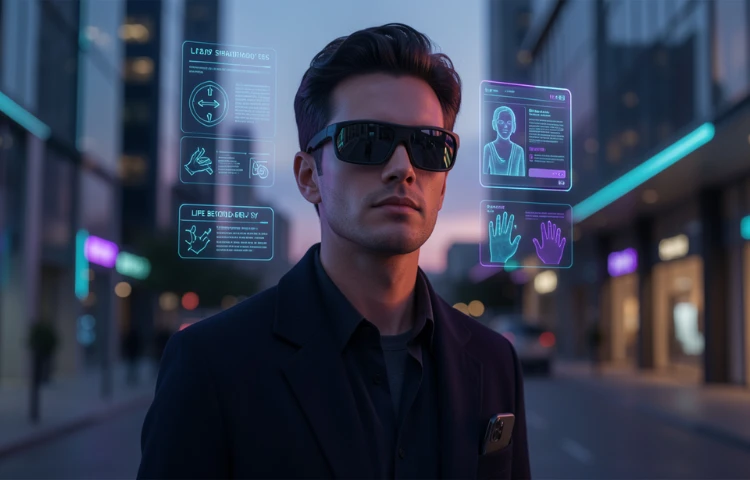
Snap is making one of its boldest technology bets yet: convincing people that the next important computer may sit on their face instead of in their pocket.
The company’s new Specs augmented-reality glasses are priced at $2,195 and designed to operate as a fully standalone wearable computer. Unlike simpler smart glasses that mainly capture photos, play audio, or provide voice-based AI assistance, Specs can place interactive digital objects, applications, directions, media, and AI-generated information directly into the wearer’s view of the physical world.
That puts Specs in an interesting middle ground. They are more capable than most lightweight AI glasses but potentially less isolating than a full mixed-reality headset. Snap is essentially arguing that people should not have to choose between staring at a smartphone and wearing something that resembles a small laptop strapped to their forehead.
The company’s [Snap Newsroom] describes the glasses as an attempt to make computing more visual, contextual, and connected to the user’s surroundings. It is a wonderfully ambitious pitch. It is also a pitch attached to a price tag that could buy several smartphones and enough coffee to rethink the purchase.
What Makes Snap Specs Different?
Specs are not simply Snapchat cameras with upgraded lenses. They are standalone spatial computers that do not require a smartphone, external processing puck, control wristband, or tethered battery pack.
The glasses use two Qualcomm Snapdragon processors. One handles computer-vision workloads such as tracking the wearer’s hands and understanding the surrounding environment, while the other runs applications and augmented-reality experiences called Lenses. Snap says this architecture helps digital objects remain responsive and properly anchored within physical spaces.
The display uses Snap’s proprietary liquid-crystal-on-silicon technology, offering a 51-degree diagonal field of view and support for 16 million colors. According to Snap, the perceived display can resemble a 24-inch desktop monitor during productivity tasks or a 115-inch screen viewed from roughly 10 feet away when watching entertainment.
Specs come in two sizes. The 47-millimeter version weighs 132 grams, while the 52-millimeter model weighs 136 grams. Removable inserts support prescription lenses, and the electrochromic lenses can shift from clear to tinted in approximately 10 seconds. Snap also claims motion-to-photon latency of seven milliseconds, an important measurement for keeping virtual content stable as the user moves.
Can Specs Really Replace a Smartphone?
Not immediately. A better way to understand Specs is as an early attempt to redistribute the smartphone’s functions across a more natural interface.
Instead of checking a phone for walking directions, a wearer could see navigation markers positioned within the street ahead. Rather than pausing a repair task to search for instructions, an AI assistant could display guidance beside the relevant component. Users could open virtual screens, browse the web, stream video, work on a spatial whiteboard, capture first-person footage, or interact with digital objects through hand and voice controls.
The [Reuters] highlights experiences ranging from AI-powered assistance and virtual workspaces to an Apollo 11 recreation and golf guidance. These examples illustrate why full AR is different from receiving a notification on a tiny heads-up display: the software can understand and respond to the environment around the user.
That contextual understanding could eventually reduce the number of times people reach for their phones. Navigation, translation, communication, shopping assistance, workplace guidance, reminders, entertainment, and search could all become ambient services available within the wearer’s field of view.
AI That Understands the Physical World
The most important Specs feature may not be the display. It may be the connection between artificial intelligence and spatial context.
Traditional AI assistants generally depend on typed prompts, uploaded images, or voice commands. Specs give software the potential to interpret objects, locations, movement, and user actions continuously. An assistant could identify what the wearer is working on, understand where help is required, and position information at the appropriate point in the physical environment.
Consider an employee maintaining industrial equipment. Instead of reading a manual on a tablet, the worker could see each step overlaid on the relevant machine. A designer could examine a three-dimensional model at room scale. A student could interact with a visualization of an electromagnetic field. A traveler could receive translated text or navigation cues without repeatedly looking down at a screen.
Snap says Specs perform processing on the device and allow users to manage saved and deleted data. However, local processing does not automatically resolve every privacy concern. Cameras, microphones, environmental mapping, and AI interpretation create sensitive data even when some of that data never reaches a remote server. [WIRED]
The Developer Ecosystem Could Decide Whether Specs Succeed
Powerful hardware is useful only when people have compelling reasons to use it.
Snap is therefore treating Specs as a platform rather than a single-purpose gadget. Developers create applications for the glasses through Lens Studio and Snap OS. The company says hundreds of Lenses have already been published and that its developer community includes hundreds of thousands of Lens Studio users.
New development tools are being introduced through Claude Code, OpenAI Codex, and Cursor. Snap is also providing a Native Development Kit, migration assistance, spatial benchmarking tools, and APIs intended to make it easier to bring existing code into the Specs ecosystem.
This is a smart strategy. The original iPhone became transformative not only because of its touchscreen, but because developers produced services that made the device indispensable. Specs need their own versions of maps, messaging, productivity tools, games, education applications, enterprise workflows, and creative platforms.
Privacy and Responsible AR Cannot Be Optional
Specs introduce familiar smart-glasses concerns at a much greater level of capability.
A visible indicator light is designed to show when the device is recording. Users can control certain saved data, and Snap says processing occurs on the device. Those are meaningful safeguards, but public trust will depend on more than an LED.
Bystanders need to understand when recording or analysis is taking place. Businesses need policies covering customer data, confidential environments, meetings, intellectual property, spatial maps, and employee monitoring. Developers need to minimize data collection and provide understandable controls for retention and deletion.
AI-generated guidance creates additional risks. A contextual assistant could misunderstand an object, present incorrect instructions, or display private information at an inappropriate moment. Applications used for education, workplace support, accessibility, or navigation will require careful testing and clear indications of uncertainty.
Competition Is About Platforms, Not Just Glasses
Snap is entering a market containing some of the world’s largest technology companies.
Meta has gained traction with Ray-Ban smart glasses and is developing more advanced display-based products. Google is building Android XR with hardware and eyewear partners. Apple has invested heavily in spatial computing through Vision Pro and is widely expected to continue exploring lighter wearable formats.
Snap’s advantage is its long history of consumer AR, its Lens Studio developer community, and its understanding of visual social interaction. Its disadvantage is scale. Building custom hardware, operating systems, AI services, developer tools, and consumer support simultaneously is brutally expensive.
The [TechCrunch] notes that Snap has established a separate company focused on bringing Specs to market. That structure signals how strategically important—and financially demanding—the project has become.
For Snap, success does not necessarily require millions of immediate sales. The first generation can establish technical credibility, attract developers, identify useful applications, and provide data for lighter and less expensive future models. In that sense, Specs may be less like a finished smartphone competitor and more like a public foundation for whatever comes next.
Conclusion
Augmented-reality glasses offer a compelling glimpse at what computing could look like beyond smartphones. By combining AI assistance, spatial displays, hand tracking, navigation, communication, and real-world context, they promise a more natural way to interact with digital information.
Still, impressive technology alone will not guarantee success. Comfort, battery life, useful applications, privacy safeguards, developer support, and public trust will ultimately determine whether AR glasses become everyday tools or remain premium devices for early adopters.
The smartphone is not disappearing anytime soon. But the direction is becoming clearer: technology is moving away from screens we constantly look down at and toward experiences that blend more seamlessly into the world around us. AR glasses may still be at the beginning of that journey, but they are already changing the conversation about what comes next.