For years, “talking to animals” sounded like something reserved for storybooks, animated movies, and that one friend who insists their dog understands tax law. But recent research into zebra finch vocalizations suggests the idea may be moving from fantasy to frontier science.
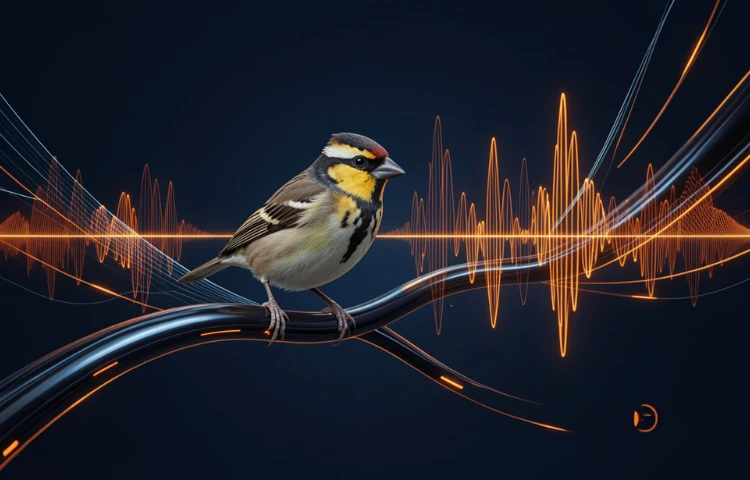
Dr. Julie Elie, a researcher at the University of California, Berkeley, has won the 2026 Coller-Dolittle Prize for Two-Way Interspecies Communication, along with a $100,000 award, for her work decoding the vocalizations of zebra finches. According to [The Guardian] Elie identified 11 core call types used by zebra finches and connected those calls to specific meanings and behaviors.
That is not just “birdsong is pretty” science. This is a serious step toward understanding how animals communicate information, identity, emotion, and intent. And yes, artificial intelligence is playing a key role.
What Did Julie Elie Actually Decode?
Zebra finches are tiny, social, and extremely vocal birds. That makes them a dream species for researchers studying communication because they produce lots of data — and in AI research, data is the birdseed that keeps the whole system chirping.
Elie spent more than a decade observing, recording, and analyzing zebra finch calls. Her research showed that these birds use distinct calls to communicate things like hunger, distress, aggression, social bonding, location, and identity. [Scientific American Feature] explains that her team did not simply label sounds from the outside; they also tested whether the birds themselves appeared to recognize the meanings of those calls.
That distinction matters. It is one thing for humans to say, “This chirp happens when the bird is hungry.” It is much more powerful to show that the birds respond as if they understand the category or meaning behind the sound. Elie’s behavioral experiments suggested that zebra finches sometimes confused calls with similar meanings more than calls that merely sounded similar, which hints at something deeper than simple acoustic pattern recognition.
Where Machine Learning Comes In
Machine learning helped researchers analyze large volumes of recordings and detect acoustic patterns across thousands of vocalizations. In earlier foundational work, Elie and Frederic Theunissen published research in [Nature Communications] showing that zebra finches use vocal signatures that allow individual recognition across call types.
In simpler terms: birds are not just saying “I’m here.” They may be saying “I’m here, and it’s me.” That is a big deal for animal communication research because it shows how identity and meaning can be layered into vocal signals.
Why This Prize Matters
The Coller-Dolittle Prize was created to encourage breakthroughs in two-way interspecies communication. The official [Coller-Dolittle Prize] describes the challenge as being inspired by the Turing test, with the long-term aim of developing algorithms that can communicate with non-human organisms using their own signals.
That is ambitious — and appropriately difficult. True two-way communication would require more than translating chirps into English. It would mean understanding context, intent, response, and meaning without projecting human assumptions onto animal behavior. The prize also includes a larger future challenge, with a major award for cracking more complete interspecies communication.
This is why Elie’s work stands out. It combines long-term biological observation, machine learning, and carefully designed behavioral validation. In other words, the science did not just ask AI to “find patterns.” It asked the birds to help confirm whether those patterns actually mattered.
The Bigger Trend: Bioacoustics Meets Artificial Intelligence
Elie’s work is part of a growing wave of AI-powered bioacoustics. Organizations like the [Earth Species Project] are working on AI tools to decode animal communication across species, while researchers are applying machine learning to birds, whales, primates, bats, and other highly vocal animals.
This trend is exciting because it expands what AI can do beyond chatbots, copilots, and productivity tools. It shows AI acting as a scientific amplifier — helping humans detect patterns too subtle, too fast, or too large-scale for manual analysis alone.
The Ethical Side: Just Because We Can Listen Does Not Mean We Should Shout Back
Here is where things get serious. If humans get better at decoding animal communication, researchers, companies, and policymakers will need strong ethical guardrails.
Animal communication tools should be non-invasive, scientifically validated, and designed with animal welfare at the center. Researchers must avoid overstating results, anthropomorphizing animal signals, or using AI-generated interpretations as if they were perfect translations. A zebra finch call is not a Slack message with feathers.
What Businesses and Innovators Can Learn
For technology leaders, this birdsong breakthrough is more than a charming science story. It is a case study in how AI succeeds when paired with domain expertise.
The lesson is simple: machine learning works best when it is grounded in high-quality data, human expertise, and real-world validation. Elie’s research was not a “feed audio into a model and wait for magic” project. It required years of careful observation, labeling, experimentation, and interpretation.
That matters for every industry adopting AI. Whether you are building models for healthcare, finance, education, sustainability, or customer experience, the same rule applies: AI needs context. Without it, models may detect patterns that look impressive but mean very little.
Final Takeaway: The Future of AI May Be a Little More Feathered
Dr. Julie Elie’s $100,000 prize is a milestone for animal communication, but it is also a reminder of what makes AI genuinely powerful. The best AI systems do not replace curiosity; they scale it. They help scientists ask better questions, process richer data, and test ideas that once felt impossible.
Decoding birdsong will not instantly give us a universal animal translator. But it does bring us closer to a future where technology helps humans understand other species with more humility, precision, and care.
And honestly, if the first message from the birds turns out to be “please refill the feeder,” we probably had that coming.