

Prefer to listen instead? Here’s the podcast version of this article.
Artificial intelligence has become remarkably good at writing reports, generating software and analyzing images. Google now wants its AI to do something considerably harder: move through the physical world without turning every unfamiliar object into a tiny mechanical crisis.
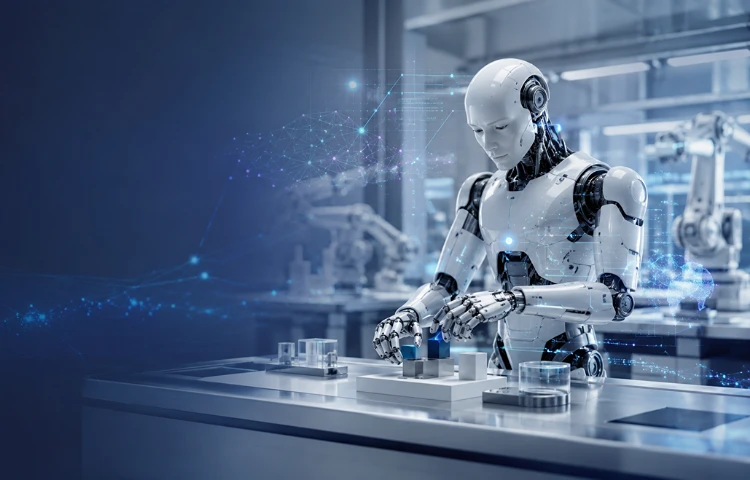
Google DeepMind introduced Gemini Robotics 2, a new generation of artificial intelligence models designed to help robots perceive their surroundings, plan actions and control their physical movements. The update expands Google’s robotics software from manipulating objects with robotic arms to coordinating complete humanoid bodies—from feet to fingertips.
According to [Google DeepMind’s Gemini Robotics 2 announcement] the system can help humanoid robots walk, crouch, stretch, maintain balance and manipulate objects as part of the same coordinated task. It also introduces more capable robotic hands, longer task sequences, local AI processing and collaboration between multiple robots.
This is not simply a software patch that makes a robotic arm move a little faster. It is part of a larger effort to build embodied AI: artificial intelligence that can understand and act within real physical environments.
Gemini Robotics 2 is not one single model. Google has organized the update around three complementary systems.
Gemini Robotics 2 is a vision-language-action model, commonly called a VLA. It processes images and natural-language instructions, then converts that information into motor commands. In practical terms, it connects what a robot sees and hears with how its joints, arms, hands and body should move.
Gemini Robotics ER 2 provides embodied reasoning. Rather than directly controlling every motor, it acts as a higher-level planner. It can interpret an environment, communicate with people, divide a complex objective into steps and monitor whether those steps have been completed.
Gemini Robotics On-Device 2 is optimized to operate locally on robotic hardware. This can reduce dependence on a permanent cloud connection while improving response speed and providing organizations with more control over sensitive operational data.
The distinction matters. A useful robot needs more than physical control. It needs to determine what should happen, understand whether an action succeeded and decide what to do when the environment changes. Google’s software stack attempts to connect those reasoning and movement layers within a more unified system.
Earlier generations of AI-powered robots were frequently demonstrated at tables or workstations. Their bases remained stationary while one or two arms manipulated nearby objects.
Gemini Robotics 2 expands that intelligence across a humanoid robot’s complete body. Google says the model can coordinate walking, bending, reaching, balancing and object manipulation without treating each action as an unrelated routine.
That coordination is more difficult than it looks. Imagine asking a robot to retrieve an object from a low shelf. The machine may need to approach the shelf, position its feet, lower its center of gravity, avoid nearby objects, reach forward, grip the item and stand up without dropping it. Every movement affects the next.
[The Verge’s report on Gemini Robotics 2] highlights how the system was demonstrated on Apptronik’s Apollo 2 humanoid platform, performing movements and manipulation tasks that require the legs, torso, arms and hands to work together.
This moves robotics closer to operating in environments designed for people. Factories can be redesigned around fixed machines, but homes, stores, hospitals and warehouses contain stairs, low shelves, narrow spaces and objects at different heights. A robot that can reposition its entire body has a much wider potential operating range.
Walking makes a humanoid robot mobile. Dexterity makes it useful.
Google says Gemini Robotics 2 can control both conventional robotic grippers and more complex five-fingered hands. Demonstrations include manipulating bags, handling lightbulbs and performing knot-related tasks—activities that involve controlling force, finger placement and object orientation.
These are meaningful tests because everyday objects are inconsistent. A rigid box behaves predictably. A plastic bag bends, slips and changes shape after every movement. A robot cannot rely on one memorized trajectory; it must continuously observe the object and adjust.
[Wired’s examination of Google’s updated robotics models] explains how the system combines visual understanding, language interpretation and physical action while learning through simulation, demonstrations and human-guided operation.
Improved dexterity could eventually support tasks such as sorting irregular products, handling tools, restocking retail shelves, preparing laboratory equipment and assisting with household organization. However, polished demonstrations should not be confused with universal reliability. A robot successfully tying one type of bag in a controlled setting does not automatically mean it can handle every bag, lighting condition or workspace.
Many industrial robots are extremely reliable because they repeat a tightly defined action in a controlled environment. General-purpose robots face a messier challenge: completing objectives that involve many decisions over several minutes.
Gemini Robotics ER 2 is designed to support longer task sequences involving hundreds of decisions. It can recognize when a task starts, identify important events, monitor progress and determine when the objective is finished.
For example, “clean this area” is not a single motor command. A robot must identify misplaced objects, decide where they belong, choose an efficient order, navigate around obstacles, manipulate each item and verify that the area is actually clean.
Google discusses these planning and orchestration capabilities in its [Gemini Robotics ER 2 overview] which focuses on video understanding, task orchestration and collaboration between robots.
Progress monitoring may be as important as planning. A robot must know whether it successfully placed an object, whether a drawer opened or whether its previous action made the situation worse. Otherwise, one small error can quietly derail an entire workflow.
Gemini Robotics ER 2 also introduces the ability for different robots to coordinate their work.
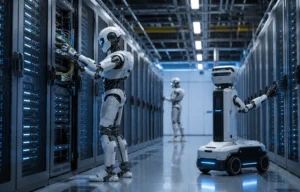
A mobile robot could transport containers while a stationary robotic arm sorts their contents. Two humanoid robots could divide a cleanup task by location. A warehouse system could assign jobs according to each robot’s tools, position, battery level and current workload.
This resembles multi-agent AI software, except the agents are attached to machines that occupy physical space. They cannot simply perform conflicting actions and refresh the page afterward. They must avoid collisions, communicate reliably and understand which robot is responsible for each step.
Multi-robot collaboration could improve productivity in manufacturing, logistics, retail and laboratory operations. It also introduces new governance questions. Organizations will need records of which system assigned an action, which robot performed it and how responsibility is handled when a coordinated workflow fails.
Robotics developers face a significant fragmentation problem. Robots come with different arms, joints, cameras, sensors and control systems. Software developed for one machine usually cannot be transferred instantly to another.
Google says Gemini Robotics On-Device 2 can adapt to new two-arm robot designs using a relatively small collection of examples gathered over a few hours. DeepMind reports that adaptation can typically be achieved with fewer than 200 examples, even when the new platform has a substantially different physical design.
This could reduce one of the largest barriers to commercial robotics: the time and expense required to retrain software for every hardware configuration.
The strategy resembles an operating-system approach. Instead of building entirely separate intelligence for every machine, developers could adapt a common AI foundation to multiple robotic bodies. Google is not at the “Android for robots” stage yet, but the direction is difficult to miss.
Cloud AI gives developers access to large amounts of computing power, but robots cannot always wait for data to travel to a remote server and return.
A machine balancing an object, responding to a nearby person or avoiding a collision may need to react immediately. Network interruptions and unpredictable latency can create unacceptable risks.
On-device processing can provide three important advantages:
Local operation does not automatically make a robot private or secure. Organizations still need to understand which information remains on the device, which data is uploaded, how software updates are authenticated and whether diagnostic logs expose sensitive environments.
[A detailed Axios report on Google’s robotics software update] frames the announcement as part of a wider industry effort to make humanoid and task-oriented robots more versatile. It also points to a practical constraint: sophisticated AI software is valuable only when organizations can obtain compatible, secure and economically viable hardware.
In manufacturing, more adaptable robots could support high-mix production, where components and workflows change frequently. In logistics, robots could handle irregular items and recover from unexpected package positions. Retailers could use mobile systems for inventory inspection and shelf organization. Laboratories could automate multi-stage procedures involving different instruments.
The near-term opportunity is unlikely to be a robot that can do absolutely everything. More realistic deployments will combine adaptable AI with clearly bounded tasks, controlled workspaces and human supervision.
Businesses evaluating embodied AI should begin with workflows that are repetitive enough to justify automation but variable enough to benefit from AI. They should also measure performance across failure rates, intervention requirements, task-completion time and adaptation cost—not just whether the robot looks impressive in a video.
AI software becomes more consequential when its decisions produce physical movement.
A chatbot error may produce inaccurate text. A robotics error can damage equipment, interrupt operations or endanger nearby people. That requires layered protection extending beyond the AI model.
Google describes safety features such as detecting human proximity, stopping unsafe movement and evaluating robotic behavior against safety benchmarks. The company has also introduced ASIMOV-Agentic, a benchmark intended to assess how embodied AI handles potentially unsafe situations.
Responsible deployments should include physical emergency stops, restricted operating zones, speed and force limits, authenticated commands, human override procedures and detailed event logs. High-risk actions should require additional verification instead of relying on one model-generated decision.
Privacy is equally important. Robots may collect video, audio, depth information and detailed maps of homes or workplaces. Employees and customers should know what is recorded, why it is needed, where it is processed and how long it is retained.
Accountability must also be established before deployment. When a system fails, responsibility cannot disappear between the model provider, hardware manufacturer, application developer and business operating the robot.
Gemini Robotics 2 represents meaningful progress, but major challenges remain.
Robots must operate reliably across unfamiliar spaces, reflective surfaces, poor lighting, moving people and objects they have never encountered. Their actions must also be repeatable enough to justify the cost of purchasing, integrating and maintaining the hardware.
Independent evaluation will be essential. Company demonstrations show what a system can do under selected conditions. Businesses need to know how frequently it fails, how long recovery takes and whether performance remains stable over thousands of operations.
Hardware availability, energy use, maintenance, cybersecurity and workforce training will also influence adoption. The smartest robotic software in the world still needs functioning motors, reliable sensors and someone who knows what to do when the machine develops an unexpected opinion about a storage bin.
Businesses do not need to purchase a fleet of humanoid robots tomorrow. They should, however, begin preparing for AI systems that can act in physical environments.
Start by identifying narrow, measurable workflows. Build digital simulations or controlled test environments before introducing robots into active workspaces. Establish safety and privacy requirements early, and involve operations teams, cybersecurity specialists and frontline employees in the evaluation.
Most importantly, judge the system by real operational outcomes. A valuable robot is not the one with the most cinematic demonstration. It is the one that completes useful work consistently, safely and at a sustainable cost.
Google’s Gemini Robotics 2 update brings together whole-body movement, advanced dexterity, embodied reasoning, on-device processing and multi-robot coordination. It signals a broader transition from AI that primarily generates information to AI that can perceive, plan and act in the physical world.
The technology is not ready to place a flawless humanoid assistant in every business or home. Yet it is becoming increasingly plausible that adaptable robotic systems will move beyond tightly controlled factory routines and into more varied workplaces.
For organizations, the opportunity is substantial—but so is the responsibility. The companies that benefit most will not simply adopt smarter robots. They will build the governance, infrastructure and human oversight needed to make those robots dependable.


WEBINAR