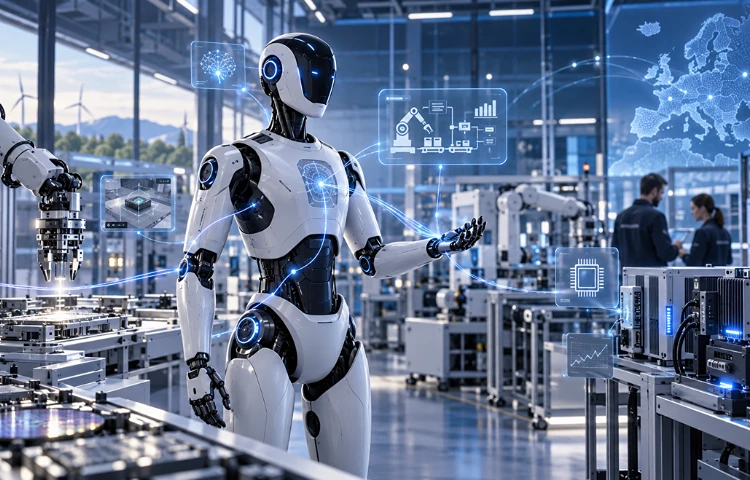
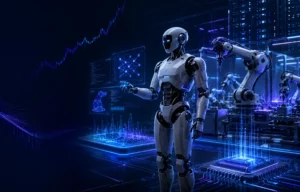
Artificial intelligence has spent years getting better at thinking inside computers. Now one of its most important challenges is learning how to work outside them.
That transition—from software that generates answers to machines that can perceive, reason and physically act—is driving the rapidly expanding field of Physical AI. And a new European partnership suggests that the race is moving beyond impressive robot demonstrations toward something much harder: industrial-scale production.
Germany-based NEURA Robotics and Italian embedded-computing specialist SECO announced a strategic partnership designed to industrialize and scale Physical AI from Europe. Under the agreement, SECO will help design, engineer and manufacture electronic compute modules for NEURA’s cognitive robots, including its humanoid 4NE1. The systems will incorporate Qualcomm Dragonwing processors as part of NEURA’s distributed computing architecture. The full partnership details are available in the [Seco]
That might initially sound like a hardware supply agreement.
It is considerably more interesting than that.
The partnership links robotics, edge AI computing, electronics manufacturing, industrial data and semiconductor production into what could become a broader European Physical AI ecosystem. And it illustrates something increasingly important about the robotics market: building an intelligent machine is no longer just a robotics problem. It is a full-stack computing, data and manufacturing problem.
The NEURA–SECO Partnership Is About Turning Robotics Into an Industry
Robotics companies are very good at producing videos that make the future look approximately three weeks away.
Commercial-scale manufacturing is less cinematic.
A robot intended to operate reliably in a factory needs industrial-grade computing, sensing, power management, safety systems, real-time control, networking, thermal engineering, durable electronics and a supply chain capable of producing the same system repeatedly.
That is where SECO enters the picture.
SECO specializes in embedded computing, edge AI and industrial electronics. Under the partnership, the company will engineer and manufacture compute modules for NEURA robots, helping move those systems from advanced platforms toward repeatable series production in Europe. Independent coverage from [Intelligent CIO] highlights the same industrialization angle: NEURA contributes cognitive robotics and Physical AI technology, while SECO provides the engineering and manufacturing capability required to turn that intelligence into scalable hardware.
That distinction matters.
There is a huge difference between building 20 sophisticated robots and reliably producing thousands of them. Manufacturing scale introduces entirely new constraints involving component availability, quality assurance, power efficiency, maintainability and cost.
The NEURA Robotics and SECO Physical AI partnership is therefore partly an attempt to solve the decidedly unglamorous problems that separate a great prototype from a viable industry.
And those problems may ultimately determine which robotics companies survive.
NEURA’s “Brain + Nervous System” Approach Could Be the More Important Story
Traditional robots often resemble centralized machines: sensor information travels to one principal computing system, decisions are made, and commands travel back to the motors and actuators.
NEURA is pursuing a more distributed architecture.
The company describes its approach as a “Brain + Nervous System” architecture, supported by its Smart Limb concept. Instead of concentrating every computational decision in one place, sensing and processing can be distributed throughout the robot and positioned closer to the joints, sensors and mechanisms where physical actions occur.
Think less “one computer operating a robot” and more “an intelligent network spread throughout the machine.”
There is a practical reason for that approach.
A cognitive robot may be reasoning at several different timescales simultaneously. High-level intelligence might determine that a component needs to be picked up and moved. Local systems must then handle much faster tasks such as maintaining balance, interpreting force, controlling a joint or reacting immediately when unexpected contact occurs.
Smart Limbs Bring AI Closer to Physical Action
Smart Limbs are particularly interesting because they point toward a different way of thinking about robot intelligence.
Imagine a worker catching a falling cup.
The brain does not need to consciously calculate every muscle movement from scratch. Different parts of the nervous system coordinate perception and physical response extremely quickly.
Robotic systems obviously work very differently from biological bodies, but the architectural principle offers a useful analogy. Distributed intelligence can allow individual robot subsystems to handle tightly constrained real-time tasks while a higher-level system concentrates on more complex reasoning.
That creates several potential advantages.
It can reduce latency, limit the amount of sensor information constantly traveling to a central processor, support modular hardware designs and improve responsiveness when robots operate close to people.
Qualcomm’s [Qualcomm] shows how seriously the broader robotics industry is taking this hardware challenge. The reference platform integrates computing, sensing, networking and software with the explicit goal of helping developers move from prototypes toward deployable robots. NEURA is listed among the ecosystem participants supporting the platform.
The Semiconductor Industry Could Become a Training Ground for Physical AI
The partnership becomes even more strategically interesting when you look beyond NEURA’s own robots.
NEURA and SECO plan to collaborate on Physical AI systems for semiconductor and electronics manufacturing, using real-world production environments to generate industrial data and develop new automation capabilities.
That creates a potentially powerful feedback loop.
Robots operate inside real production environments. Their interactions produce data. That data can help developers improve perception, manipulation and decision-making. New skills can then be refined, validated and deployed across additional robots and manufacturing sites.
The objective is not simply to program one machine to repeat one movement forever.
It is to create reusable intelligence.
Coverage from [Unite] emphasizes this connection between European manufacturing, robot compute modules and scalable Physical AI infrastructure.
This is also why real-world industrial data is becoming so valuable.
Generative AI could learn enormous amounts from material already stored on the internet. Physical AI does not have the same luxury. A humanoid learning to manipulate irregular components, respond to changing factory conditions or recover from unsuccessful actions needs data describing physical interactions—not just text describing them.
NEURA Gym Could Help Build the Data Flywheel
NEURA and SECO are also discussing the creation of a NEURA Gym in Italy, which would become NEURA’s first training hub in Southern Europe.
The name may sound like a place where humanoids finally get serious about leg day, but the concept addresses one of robotics’ biggest bottlenecks: training.
Physical AI systems need experience.
Developers require environments where robots can practice tasks, collect interaction data, validate new capabilities and improve models before those systems enter production environments.
Real-world training hubs can complement simulation by providing data involving friction, imperfect components, unexpected obstacles, human behavior and other details that digital environments may struggle to reproduce perfectly.
That creates what the AI industry increasingly describes as a data flywheel: deploy systems, observe what happens, learn from those interactions, improve the models and redeploy the improvements.
NEURA’s broader Neuraverse vision extends the idea further. Skills developed through one robot or application could eventually become reusable capabilities available to other machines rather than remaining isolated inside a single custom automation project.
This shift from isolated automation toward reusable physical intelligence could be one of the most commercially important developments in robotics.
Why Europe Matters to This Partnership
The words “from Europe” in the announcement are not decorative.
The partnership is explicitly framed around developing and manufacturing important parts of the Physical AI stack in Europe.
Europe already possesses several ingredients that could make it unusually competitive in Physical AI: world-class manufacturing, industrial automation, automotive engineering, robotics research, sensors, embedded systems and enormous quantities of specialized industrial knowledge.
Where Europe has struggled more visibly is in the enormous centralized computing infrastructure and frontier AI platforms that have made American technology companies dominant during the generative-AI boom.
Physical AI changes the competitive equation somewhat.
A robot in an automotive factory or semiconductor facility requires more than a giant language model. It needs mechanical engineering, embedded electronics, real-time systems, industrial data, sensors, manufacturing capabilities, safety expertise and close integration with real production workflows.
What Businesses Should Watch Next
For executives, manufacturers and technology leaders, the significance of the NEURA–SECO agreement extends beyond whether 4NE1 becomes the dominant humanoid robot.
The partnership reveals several signals worth watching:
- Physical AI is moving toward industrialization. The conversation is increasingly about manufacturing capacity, embedded computing and repeatable deployment rather than demonstrations alone.
- Edge computing will be critical. Robots need local intelligence capable of responding quickly even when cloud connectivity is limited.
- Real-world operational data may become a competitive asset. Companies that can responsibly turn production experience into reusable robotic skills could create powerful feedback loops.
- Ecosystems may matter more than individual vendors. Robotics increasingly requires collaboration among AI developers, semiconductor companies, manufacturers, integrators and industrial customers.
- Europe has a plausible Physical AI advantage. Its industrial base, robotics expertise and engineering infrastructure could allow it to compete differently from regions dominating cloud-based generative AI.
That last point deserves particular attention.
The Physical AI race may not be won by the company capable of producing the most entertaining humanoid demonstration.
It may be won by the ecosystem that can manufacture robots reliably, train them on valuable real-world tasks, update them safely and repeat that process thousands of times.
Conclusion
The partnership between NEURA Robotics and SECO shows how quickly Physical AI is moving from research and prototypes into real-world manufacturing. By combining NEURA’s intelligent robots with SECO’s embedded computing and production expertise, the two companies are working to make advanced robotics easier to build, scale, and deploy across Europe.
The bigger story is that AI is no longer limited to software on a screen. It is becoming part of machines that can see, understand, move, and work alongside people. For businesses, this could mean smarter factories, more flexible automation, and new ways to improve productivity.
Europe also has an opportunity to play a major role in this shift because of its strong manufacturing, robotics, and engineering industries. If partnerships like NEURA and SECO succeed, Europe could become an important center for the development of safe, reliable, and scalable Physical AI.
Ultimately, the future of AI may not only be about systems that can answer questions. It may also be about intelligent machines that can understand the physical world and take useful action within it.