

Prefer to listen instead? Here’s the podcast version of this article.
The age of the AI chatbot may be giving way to something considerably more powerful—and considerably more complicated.
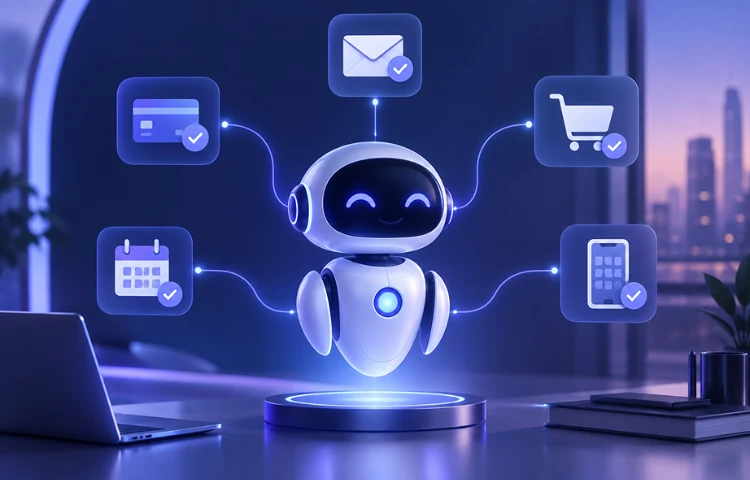
Meta introduced Muse, a personal AI agent designed not merely to answer questions but to take actions on a user’s behalf. The Meta AI agent can connect with other apps and services, send emails, book travel, fill out forms, make purchases and continue working on tasks even after a user closes the app.
That is a substantial leap from asking an AI, “Can you draft this email?” to saying, “Handle this,” and watching the software actually do it.
According to [Meta’s official Muse announcement] the company sees Muse as part of a broader shift toward personal AI capable of turning goals into actions rather than simply producing information.
The launch puts Meta squarely into the rapidly expanding race to build agentic AI—AI systems that can reason about a goal, interact with outside software and perform a sequence of actions with less step-by-step human involvement.
And while the productivity possibilities are huge, so are the questions around permissions, privacy, security, financial transactions and accountability.
Muse is Meta’s attempt to move AI from an assistant sitting inside a chat window to something closer to a digital operator.
Traditional generative AI generally waits for a question and generates an answer. An AI agent can instead interpret a goal, create a plan, use tools and execute parts of that plan.
Meta says Muse runs using its agent-focused AI technology and operates within a dedicated cloud-based environment designed to let the system interact with connected services while maintaining security controls.
That environment gives Muse access to a browser-like workspace for completing tasks across different services. The system can also continue working in the background while the user does something else.
Meta is positioning Muse as a general-purpose personal agent rather than an assistant dedicated to one application.
The company says users can connect services across areas including email, calendars, payments, shopping, dining, entertainment and other digital services. From there, the agent can coordinate actions spanning multiple applications.
Muse can potentially:
The significance is not any one of those features. The important part is cross-application execution.
The [Associated Press coverage of Meta’s personal AI agent] highlights the growing difference between traditional conversational AI and agentic systems capable of acting across digital services.
Muse becomes more useful as it understands more about the user.
That is simultaneously its biggest advantage and one of its biggest privacy challenges.
A personal agent might benefit from knowing your calendar, travel preferences, favorite stores, dietary requirements, purchasing habits and communication patterns.
But bringing those pieces together can potentially create an unusually detailed representation of an individual’s digital life.
Meta has emphasized privacy controls as part of the Muse design. The company outlines its approach to user data, connected services and future privacy protections in its [official product announcement].
The challenge is that personal agents require context to become genuinely useful.
An assistant that knows nothing about you cannot do much on your behalf.
An assistant that knows everything about you raises a very different set of questions.
Finding the right balance may become one of the most important product-design problems in consumer AI.
Meta has made security one of the central themes of the Muse launch. However, independent reporting also shows why caution remains appropriate.
[Reuters’ reporting on the Muse launch] examined Meta’s development process and reported concerns arising during internal testing, including reliability and data-handling issues.
That is arguably the central tension surrounding every powerful AI agent.
An agent needs enough authority to be useful.
Every additional permission also expands the consequences when the agent misunderstands instructions, encounters malicious content, receives a deceptive prompt or simply fails.
[TechCrunch’s analysis of Muse and the consumer trust question] also focuses on a key challenge facing Meta: convincing consumers to give an AI system access to services containing valuable and highly personal information.
The technical problem is therefore only half the challenge.
The other half is earning enough trust that people will actually connect those accounts.
Muse is launching as a consumer-focused product, but enterprise technology leaders should pay close attention.
Consumer platforms often create expectations that eventually migrate into the workplace.
Employees accustomed to telling a personal AI, “Plan this trip and book it,” will increasingly expect business software to respond to requests such as:
“Review these invoices, identify discrepancies, update the system and send me the exceptions.”
Or:
“Find available meeting times across these teams, prepare the briefing material and schedule the meeting.”
The underlying shift is from software as a collection of interfaces to AI as an orchestration layer across software.
That could significantly affect SaaS platforms, ecommerce companies, financial institutions, CRM providers, travel businesses and virtually any company whose customers currently interact through websites and apps.
Tomorrow’s customer may not always be a human clicking your interface.
Sometimes it may be an agent operating on the human’s behalf.
Possibly—but the most important part of Muse is not whether this particular product becomes the dominant personal agent.
It is what the launch tells us about where the technology industry is heading.
Meta is betting that the next phase of AI is not primarily about answering better questions.
It is about taking better actions.
The company has enormous distribution through its existing platforms, giving it a potential path to put agentic AI in front of mainstream consumers rather than limiting the technology to developers and early adopters.
[Reuters’ coverage] provides additional detail on Meta’s positioning of Muse and the broader competitive race around personal AI agents.
If agents become reliable enough, the familiar routine of opening apps, navigating menus and manually transferring information between services could gradually disappear.
But the winners will not simply be the companies whose agents can perform the greatest number of tasks.
They will be the companies whose agents users trust enough to let them perform those tasks.
Meta’s Muse AI agent is a clear sign that artificial intelligence is moving beyond conversation and into action. The ability to access apps, send emails, coordinate tasks and participate in payments could make AI far more useful in everyday life—but it also raises the stakes for privacy, security, permissions and accountability.
For businesses, the takeaway is bigger than one Meta product. Agentic AI is becoming a new interface for how people may interact with software, services and commerce. Companies that prepare now for AI-driven workflows, secure integrations and human approval systems will be better positioned as this shift accelerates.
For consumers, the key question will be trust. The most successful AI agents will not simply be the ones that can do the most—they will be the ones people feel comfortable allowing into their inboxes, calendars, accounts and financial workflows.
Meta Muse may still be an early step, but it points toward a future where AI does more than recommend the next move. It may increasingly make that move for us.











WEBINAR
