We have officially entered the era where “I didn’t know it was going to rain” is becoming a much harder excuse to defend.
Google DeepMind and Google Research have introduced WeatherNext 3, Google’s latest AI weather model and its most advanced global forecasting system to date. Rather than simply making an existing forecast algorithm a little faster, WeatherNext 3 represents a more fundamental change in how artificial intelligence can observe the atmosphere, interpret rapidly changing conditions and turn that information into forecasts people can actually use.
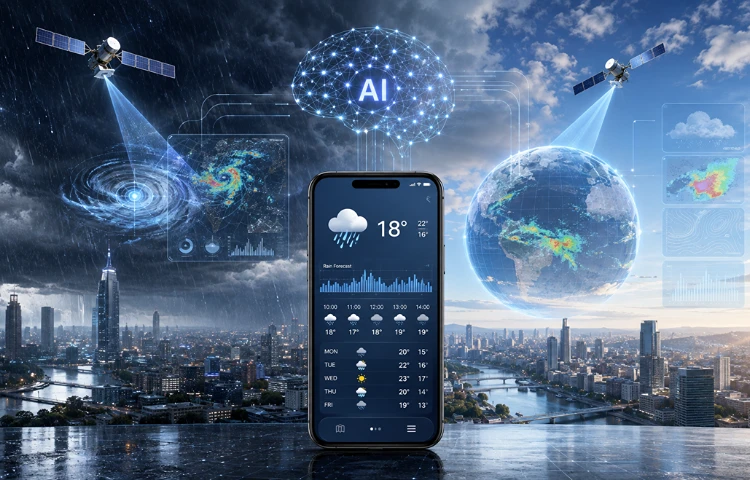
According to Google’s detailed [WeatherNext 3 announcement] the model combines live global satellite observations with machine learning to produce updated forecasts every hour. Selected surface variables can be modeled at resolutions as fine as approximately five kilometers, giving the system a much more detailed view of local conditions than its predecessor. Google says WeatherNext 3 is roughly five times sharper overall than WeatherNext 2, which generally operated on a 25-kilometer grid with six-hour forecast intervals.
That might sound like an impressive collection of meteorological statistics. But the practical implication is much simpler: Google wants AI weather forecasting to become more local, more current and much better at answering the question everyone actually asks.
Is it going to rain where I am?
What Exactly Is WeatherNext 3?
Traditional numerical weather prediction is one of the most computationally demanding scientific tasks on Earth. Meteorological agencies feed observations from satellites, weather stations, aircraft, radar systems, ocean buoys and other instruments into enormous physics-based models. Supercomputers then solve equations describing how pressure, moisture, temperature and wind are expected to evolve.
These systems remain essential to modern meteorology, but they can require substantial computing resources and time.
AI weather models approach the challenge differently. Instead of explicitly calculating every atmospheric interaction from first-principles physics, machine-learning systems learn patterns from enormous quantities of historical and observational weather data.
WeatherNext 3 pushes that idea further by incorporating a mosaic of live geostationary satellite observations into its forecasting process. That matters because many earlier AI forecasting systems depended heavily on numerical weather prediction analyses that could arrive with several hours of delay.
Weather has the inconvenient habit of changing while your computer is calculating it.
WeatherNext 3 can instead incorporate newer observations and generate another forecast every hour, allowing the model to respond more quickly when storms, fronts or rainfall systems begin developing.
The Big Breakthrough: Better Rain and Snow Forecasts
Ask a meteorologist what is particularly difficult to forecast and precipitation will quickly enter the conversation.
Rainfall and snowfall depend on small-scale cloud processes, atmospheric instability, moisture and rapidly changing local conditions. Global models frequently have to represent these processes across relatively large grid cells, which can make precipitation appear blurred or place rainfall slightly away from where it eventually occurs.
WeatherNext 3 was designed specifically to improve this weakness.
Google trained parts of the system using high-quality precipitation datasets including NASA’s Integrated Multi-satellite Retrievals for GPM, better known as IMERG, alongside Google’s own satellite-radar precipitation reanalysis.
Google reports significant improvements across several precipitation evaluation metrics. In medium-range testing, the company reports improvements in Continuous Ranked Probability Score of up to 60% against IMERG observations, alongside improvements measured against U.S. radar and rain-gauge datasets. For consumer-facing forecasts made at least a day ahead, Google says people could see precipitation forecasts that are up to 50% more accurate in some circumstances.
The words “up to” matter. Weather is chaotic, forecast accuracy varies by region, lead time and measurement method, and no model suddenly makes precipitation perfectly predictable.
Still, better rain forecasting could have a surprisingly large impact.
[TechCrunch’s report on WeatherNext 3] notes that rain prediction, coarse spatial resolution and dependence on processed government datasets have historically been persistent weaknesses for AI weather models. WeatherNext 3 is designed to attack all three problems at once.
So yes, the umbrella joke is funny. The underlying technology is considerably more serious.
Five-Kilometer Detail Changes What a “Global Forecast” Can Mean
WeatherNext 3 also increases forecasting resolution.
Selected surface measurements, including station-calibrated temperature and dew point, can reach roughly five-kilometer resolution. Core gridded surface variables can operate closer to approximately ten kilometers, while other atmospheric variables are modeled at broader resolutions. In other words, WeatherNext 3 is not universally a five-kilometer forecasting system, but it can produce dramatically finer detail for important variables than WeatherNext 2.
Why does that matter?
Consider a coastal city, mountain valley or densely populated metropolitan region. Conditions separated by only a few kilometers can be surprisingly different. Mountains alter wind and precipitation. Coastlines influence temperature and humidity. Urban areas produce their own heat effects.
A 25-kilometer grid can smooth away some of those differences.
A five-kilometer-scale prediction can reveal much more of them.
[The Verge’s coverage of WeatherNext 3] highlights this combination of higher resolution and hourly satellite-informed updates, particularly for regions that historically have had fewer ground-based weather instruments.
That could make the technology especially important across parts of Africa, Latin America and Asia-Pacific, where building dense radar and meteorological infrastructure can be extremely expensive. Google says observationally driven AI forecasting could help bring higher-quality localized weather information to areas that have traditionally had less forecasting infrastructure.
WeatherNext 3 Is Coming Directly to Google Products
WeatherNext 3 is not being kept inside a research lab.
Google says its forecasts are being incorporated into Google Search, Gemini, Google Maps, Google Maps Platform and Google Earth Engine, while developers and researchers can also work with WeatherNext capabilities through Google’s cloud ecosystem.
That distribution may ultimately matter almost as much as the underlying model.
A meteorological breakthrough does not help many ordinary users when accessing it requires specialist software and atmospheric-science expertise. Putting AI forecasts inside Search, Maps and Gemini potentially puts the output in front of billions of users through interfaces they already understand.
Imagine asking Gemini whether an outdoor meeting should be moved indoors, checking Maps before driving into an approaching storm, or searching the weather for an upcoming weekend trip and receiving a more accurate precipitation outlook.
AI Is Also Getting Better at Forecasting Hurricanes
WeatherNext 3 did not appear from nowhere.
Google DeepMind has spent years developing AI systems for different parts of weather forecasting, including GraphCast, GenCast and specialized cyclone-prediction capabilities.
In August 2026, Google DeepMind published additional research showing how its WeatherNext technology could improve predictions of tropical-cyclone tracks, intensity and wind structure. The company said the system could potentially provide forecasters with roughly an additional day of useful warning in some circumstances. Readers interested in the severe-weather side of Google’s research can explore DeepMind’s
Extra warning time is not merely a more convenient forecast.
For hurricanes and typhoons, additional preparation time can influence evacuation planning, emergency logistics, transportation, business continuity and disaster response.
This is where AI forecasting moves from useful consumer technology into potentially life-saving infrastructure.
But Physics-Based Weather Models Are Not Going Away
It is tempting to frame AI weather prediction as an “AI versus traditional meteorologists” competition.
Reality is more interesting.
WeatherNext 3 still exists within a forecasting ecosystem built on decades of atmospheric science, observational infrastructure and numerical modeling. Weather agencies also rarely rely on a single forecast. Professional meteorologists compare multiple models, ensembles, observations and expert analyses before issuing official warnings.
Google itself explicitly tells users to rely on their local meteorological agency or national weather service for official forecasts, severe-weather warnings and public-safety advisories.
The likely future, therefore, is not AI replacing physics.
It is AI working alongside physics-based forecasting, observations and human expertise.
Google Research’s work on [NeuralGCM and AI-enhanced global precipitation modeling] illustrates this hybrid direction particularly well. NeuralGCM combines machine learning with physical modeling rather than treating the two approaches as mutually exclusive.
The most powerful future forecasting systems may be the ones that know when to use physics, when to use learned patterns and how to combine both.
Weather AI Also Raises Questions About Trust and Governance
As AI becomes integrated into systems that influence public safety and major economic decisions, accuracy cannot be the only consideration.
Organizations using AI-generated environmental predictions may also need to think about model transparency, uncertainty, validation, accountability and human oversight.
A consumer deciding whether to bring an umbrella can tolerate a wrong prediction.
An emergency-management agency, electric-grid operator or agricultural business may face significantly greater consequences.
That distinction makes responsible deployment essential. Forecasts should communicate uncertainty rather than creating false confidence, critical decisions should maintain human review, and organizations should understand the limitations of the data and models they rely on.
Conclusion
Google’s latest AI weather model, WeatherNext 3, shows how artificial intelligence is becoming useful in everyday life, not just in chatbots and business tools. By using live satellite data, updating forecasts more often and improving predictions for rain, snow and severe weather, the model could help people and businesses make better decisions.
The biggest benefit is simple: more accurate and more local weather forecasts can help us plan ahead. That could mean remembering an umbrella, changing travel plans, protecting crops, managing energy use or preparing earlier for dangerous storms.
WeatherNext 3 is not a replacement for meteorologists or official weather agencies. Instead, it is another powerful tool that can support experts and improve the information available to the public.