

Prefer to listen instead? Here’s the podcast version of this article.
Artificial intelligence has already transformed how we write, code, analyze information, and solve complex problems. Now, some of the biggest names in technology are pursuing something considerably more ambitious: using AI to understand and predict how living cells behave.
Google DeepMind, Meta, and Isomorphic Labs committed a combined $300 million to the Virtual Biology Initiative led by Biohub, the nonprofit biomedical research organization founded by Mark Zuckerberg and Dr. Priscilla Chan.
The investment forms part of a broader $1.8 billion initiative involving technology companies, scientific institutions, and the U.S. government.
As reported by [TheVerge] the initiative aims to develop comprehensive biological datasets that could eventually allow scientists to simulate cellular processes using AI.
Imagine researchers being able to investigate how a cell might respond to a potential treatment before carrying out an expensive laboratory experiment.
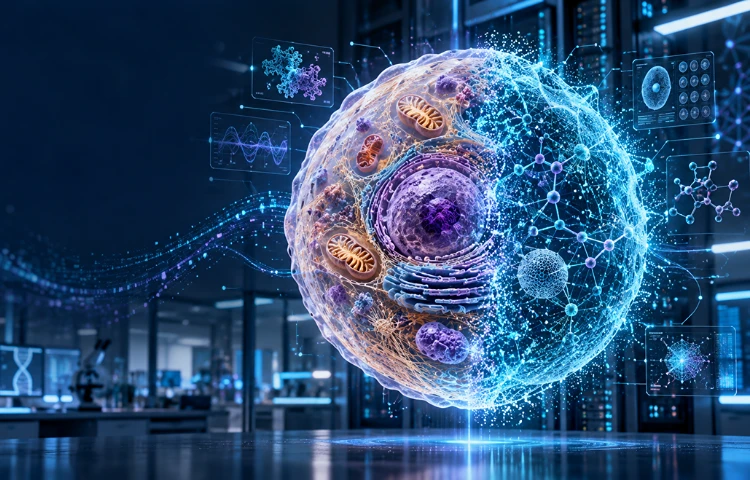
A virtual cell is an AI-powered computational model designed to represent and predict aspects of a living cell’s behavior.
To understand why this matters, consider how traditional biological research works.
Scientists studying a disease often need to conduct laboratory experiments involving different cell types, genetic changes, chemical compounds, and environmental conditions. These experiments require specialized equipment, time, funding, and extensive validation.
A virtual cell could help researchers explore some of these possibilities digitally before deciding which experiments deserve further investigation.
For example, scientists might eventually use such a model to predict:
The goal is not to replace real-world laboratory experiments. Instead, AI could help scientists select better experiments, reduce unnecessary repetition, and learn more from each result.
Think of it as a sophisticated flight simulator for biology. A pilot trains in a virtual environment before entering a real aircraft. Similarly, researchers could use virtual cells to investigate hypotheses before moving to physical experiments.
There is one important difference, however: biology is enormously complicated, and a fully reliable virtual cell does not yet exist.
Developing one remains an ambitious scientific research challenge.
The financial scale of this collaboration demonstrates how seriously leading technology organizations are taking AI-powered biology.
According to [Reuters] several major organizations are contributing funding, technology, research capabilities, and existing scientific resources.
The commitments include:
Google DeepMind, Isomorphic Labs, and Meta — $300 million combined
The three organizations are collectively investing in the development of technologies and biological datasets. The individual contribution from Google DeepMind has not been publicly specified.
Biohub — $500 million
Biohub announced its foundational commitment in April 2026, including funding for new experimental technologies, biological data generation, and collaborative scientific research.
U.S. Department of Energy — More than $500 million
Over five years, the Department of Energy plans to support laboratory measurement, computational modeling, and AI-enabled biological research.
National Institutes of Health — Existing research resources
The NIH will coordinate relevant scientific datasets, repositories, and knowledge bases developed through more than $500 million in previous federal investment.
Importantly, the widely reported $1.8 billion total represents a combination of funding, data, computing, and technological resources. It should not be interpreted as $1.8 billion entirely in new cash investments.
This distinction matters because the project is about building research infrastructure, not merely financing another AI application.
Biohub initially introduced the Virtual Biology Initiative in April 2026, with the objective of accelerating the development of predictive models of cellular biology.
Its expanded October announcement brought technology companies, federal agencies, and scientific institutions into a larger coordinated effort.
In [Biohub] the organization explains its plans to produce large-scale, standardized biological datasets that researchers around the world can use to develop predictive AI models.
This approach addresses one of the biggest obstacles to progress in biological AI: the shortage of comprehensive, high-quality experimental data.
Unlike language models that learn from enormous collections of digital text, biological AI systems require data gathered from real living systems.
And cells are exceptionally complex.
The behavior of a cell can depend on its type, physical environment, genetic activity, developmental state, and interactions with neighboring cells.
Understanding these relationships requires measurements across many different conditions.
Biohub’s strategy is therefore to build the underlying data foundation before expecting AI models to deliver reliable predictions.
That could be the initiative’s most important contribution.
Creating a useful virtual cell requires much more than feeding biological terminology into a large language model.
Scientists must gather different types of experimental measurements, connect them into standardized datasets, and train AI systems to recognize how biological processes respond to changes.
The initiative emphasizes several technologies.
Modern genomic technologies allow researchers to study molecular activity within individual cells.
Spatial transcriptomics adds information about where that activity occurs within tissue, providing context that isolated cell measurements may miss.
Combining these measurements could help AI systems understand how cells behave in different biological environments.
High-resolution imaging technologies, including cryo-electron tomography, can reveal structural details within cells.
These measurements help researchers connect molecular activity with the physical organization of cellular components.
The project aims to combine information from several biological measurement methods into multimodal datasets.
AI models trained on these datasets could learn relationships between cellular structure, gene activity, experimental interventions, and observed biological responses.
A model becomes scientifically valuable when its predictions can be tested against previously unseen experimental results.
Scientists will need to determine whether virtual cell models can consistently predict real cellular outcomes, not simply reproduce patterns from their training data.
The broader scientific importance of this coordinated approach is highlighted in the [Sanger]
The institute describes how major scientific organizations are working together to generate accessible biological data that could support future predictive models.
This represents a significant shift toward collaborative, data-intensive biology.
Perhaps the most exciting application of virtual cell technology is its potential to improve how researchers discover and develop treatments.
Traditional drug development involves extensive biological investigation, laboratory testing, preclinical studies, and clinical trials.
Each stage presents scientific uncertainty.
AI-powered virtual cells could eventually help researchers address some of that uncertainty earlier.
Scientists could use predictive models to investigate how cellular systems might respond to different therapeutic interventions.
Rather than testing every possible hypothesis immediately in the laboratory, researchers could prioritize the most promising candidates.
This would not eliminate experimental testing, but it could make the earliest stages of discovery more focused.
Many diseases involve interacting biological mechanisms rather than a single defective gene or protein.
Virtual cell models may eventually help scientists investigate how these processes influence one another.
This could support research into cancer, neurodegenerative conditions, inflammatory diseases, and other complex biological problems.
Another potential benefit is the development of common datasets and standards that scientists can use across institutions.
Researchers who previously worked with fragmented biological information could gain access to more consistent resources.
This could improve reproducibility, support collaboration, and make advanced biological AI research more accessible.
These possibilities remain goals rather than demonstrated clinical outcomes. A predictive virtual cell is not equivalent to an approved medical treatment or a replacement for clinical trials.
Google DeepMind has already demonstrated how AI can help researchers tackle difficult problems in molecular biology.
Its work in protein structure prediction, genomics, and scientific machine learning has shown that AI can be valuable when models are supported by appropriate scientific data and rigorous evaluation.
However, predicting aspects of a protein’s structure is different from accurately predicting the behavior of an entire living cell.
A living cell contains interacting molecules, regulatory systems, and changing environmental conditions.
Developing models for such systems requires new measurement technologies, much larger datasets, and considerable computational resources.
This is where Biohub’s initiative could complement existing advances.
For Google DeepMind and Isomorphic Labs, supporting better biological data infrastructure could strengthen the scientific foundation for future research tools.
For Meta, involvement expands its participation in collaborative AI research beyond conventional consumer and enterprise applications.
And for Biohub, the investment brings together scientific expertise, computational resources, and long-term institutional support.
The commercial and scientific opportunities are substantial, but so are the technical uncertainties.
It is tempting to imagine a future where researchers type a question into an AI system and immediately receive an accurate answer about human biology.
The reality is much more complicated.
AI systems must distinguish between correlation and genuine biological cause and effect.
A model trained on certain cell types may perform poorly when presented with unfamiliar tissues, conditions, or experimental interventions.
Other challenges include incomplete datasets, measurement errors, inconsistent research methods, and biological differences between individuals.
There is also a risk that impressive benchmark performance could create unrealistic expectations about clinical usefulness.
For virtual cell technology to become trustworthy, research teams will need to demonstrate reliable predictions under carefully controlled conditions.
That means using independent validation datasets, documenting model limitations, comparing predictions with laboratory results, and making scientific methods reproducible.
Beyond the technology itself, the Virtual Biology Initiative raises important questions about who gets access to advanced biological data and how that access should be governed.
According to [Axios] commercial partners are expected to receive a one-year period of exclusive access to data they help develop before the information becomes publicly available.
This arrangement is intended to encourage private investment while eventually supporting a wider scientific community.
However, it also introduces a legitimate debate.
If organizations receive early access to foundational research datasets, could that provide advantages in developing proprietary models and future commercial products?
The initiative’s long-term credibility will depend partly on how transparently these arrangements are managed.
Other important considerations include:
Data privacy and consent: Biological research involving human-derived information requires appropriate safeguards, particularly when genomic or potentially identifiable data is involved.
Bias and representation: AI models should be evaluated across diverse cell types, biological conditions, and relevant population groups.
Transparency and reproducibility: Researchers need sufficient information to understand model capabilities, data provenance, and potential limitations.
Scientific accountability: Predictions that influence medical research decisions must be subject to appropriate human oversight and experimental validation.
Regulatory readiness: If virtual cell technologies eventually support clinical decisions or regulated medical products, developers will need to consider applicable requirements from organizations such as the U.S. Food and Drug Administration.
Responsible innovation will be just as important as computational performance.
Biohub has outlined an ambitious five-year direction for its initiative.
In reporting published on October 7, 2026, Biohub Head of Science Alex Rives said the organization aims to make an initial large-scale dataset available within approximately one year and develop accurate predictive models within five years.
These are research ambitions, not guaranteed delivery dates.
The first milestone will be demonstrating that increasingly comprehensive biological datasets can meaningfully improve AI prediction quality.
Subsequent milestones will require researchers to show that models generalize across biological settings and produce useful predictions that can be independently validated.
Even after that, translating advances in virtual biology into better medicines could require substantial additional research and clinical testing.
The distinction between a successful scientific model and a successful medical treatment remains crucial.
Google’s investment in Mark Zuckerberg’s ambitious virtual cell initiative marks a significant step toward the future of AI-powered biology, healthcare innovation, and drug discovery. With Google DeepMind, Meta, and Isomorphic Labs collectively committing $300 million to Biohub’s Virtual Biology Initiative, the collaboration demonstrates how artificial intelligence is expanding beyond traditional applications to address some of the most complex challenges in medical science.
By combining advanced AI models, high-quality biological datasets, and computational research, the initiative aims to help scientists better understand cellular behavior, predict disease mechanisms, and accelerate the discovery of potential treatments. Although fully functional virtual cells remain a long-term scientific goal, their development could eventually reduce research costs, improve experimental efficiency, and open new possibilities for personalized medicine.
However, the success of virtual cell technology will depend on more than technological advancement. Ensuring data accuracy, ethical AI development, scientific transparency, and responsible governance will be essential for building trustworthy systems that deliver meaningful healthcare benefits.
For businesses, researchers, and technology leaders, this development highlights a broader transformation: AI is becoming a powerful tool not just for automating existing processes but also for enabling new forms of scientific discovery.







WEBINAR