Novo Nordisk—now increasingly using the shortened name Novo—announced a collaboration with Anthropic focused on applying Claude AI to pharmaceutical research and development. The objective is ambitious but practical: help researchers solve difficult scientific problems, improve biological reasoning, accelerate software development, and ultimately shorten the path between an early research question and a potential new medicine. Novo’s official announcement says the initial effort will involve testing Claude Science on specific R&D workflows and identifying scientific problems where the combined expertise of Novo and Anthropic could have the greatest impact. [Novo]
That distinction matters. Anthropic and Novo have not announced that Claude is independently inventing a particular new drug or replacing experimental scientists. What they are building is arguably more interesting: an AI-assisted research environment capable of connecting scientific literature, data, computational tools, reasoning, software development, and human expertise.
Reuters independently reported the collaboration as part of Novo’s broader effort to speed medicine development using AI. [Reuters]
Claude Science Could Become an AI Workbench for Novo Researchers
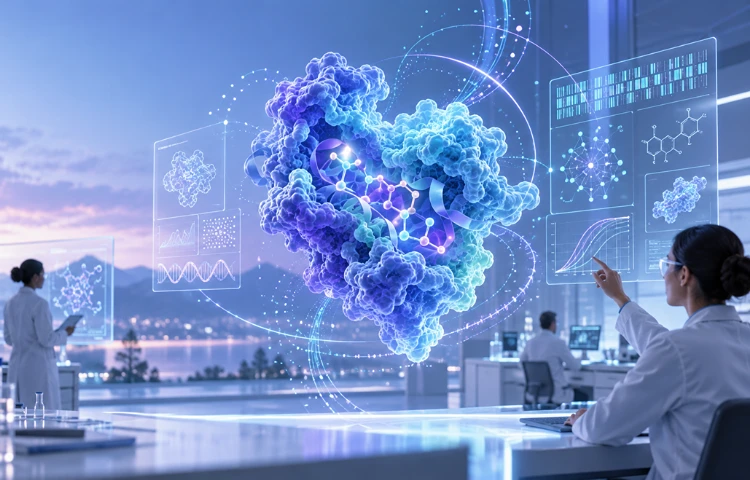
The most important technology in this collaboration may be Claude Science, Anthropic’s specialized AI environment for scientific research.
This is not simply the regular Claude chatbot with a collection of biology prompts attached. Anthropic designed Claude Science to integrate many of the tools researchers already use, manage computational workloads, analyze scientific literature and data, create reproducible research artifacts, and coordinate specialist AI agents.
According to Anthropic, Claude Science includes more than 60 curated skills and connectors across areas such as genomics, proteomics, structural biology, single-cell analysis and cheminformatics. It can also interact with scientific databases and computational resources while preserving an audit trail showing how analyses, figures and conclusions were produced. [Anthropic]
For a pharmaceutical company, that could be significant.
Drug discovery rarely involves one database, one experiment or one brilliant eureka moment. Scientists may need to evaluate published research, examine genomic data, compare biological pathways, analyze molecular properties, run computational models, inspect previous experimental results and decide what experiment should happen next.
Traditionally, much of that work happens across fragmented systems.
Claude Science is designed to act as something closer to an intelligent coordination layer across those systems.
Claude Could Help Researchers Reason Across Complex Biological Evidence
Novo says the partnership will specifically explore workflows that support biological reasoning.
That phrase deserves attention.
Biology is extraordinarily interconnected. Understanding whether a potential therapeutic target is worth pursuing can involve genetics, protein interactions, cellular pathways, disease mechanisms, experimental data, existing literature and evidence from previous programs.
Humans are exceptionally good at forming hypotheses and applying scientific judgment. Humans are considerably less good at simultaneously reading millions of documents and databases.
That is where an advanced AI research system becomes useful.
Claude could potentially help researchers gather evidence from different sources, identify relationships between findings, summarize contradictory evidence, compare hypotheses and expose gaps that deserve further investigation. Scientists can then evaluate those outputs and determine which ideas deserve experimental testing.
Chemistry Is Another Area Where Claude Is Becoming More Capable
Anthropic has also been working directly on Claude’s ability to reason about chemistry.
In June 2026, the company published research exploring Claude’s performance on nuclear magnetic resonance, or NMR, spectroscopy—a fundamental technique chemists use to determine molecular structures.
Anthropic tested Claude models against established chemistry tools on a set of compounds from research published after the models’ training cutoff. The company reported particularly strong results from its most capable model on parts of the NMR prediction task, while also emphasizing that the broader goal is to assist chemists with translation, analysis and information integration rather than eliminate expert judgment.
Why does that matter for the Novo partnership?
Drug research constantly moves between different representations of scientific information: molecular structures, journal figures, experimental measurements, database entries, chemical notation and laboratory results.
An AI system capable of understanding several of these formats could reduce repetitive analytical work and help scientists move between them more efficiently.
Instead of spending valuable research hours translating information between systems, researchers could spend more time asking the questions that actually require human scientific expertise.
Agentic AI Could Change How Pharmaceutical R&D Software Is Built
The partnership is not limited to biology.
Novo specifically says it intends to use Anthropic’s frontier models to strengthen AI-driven software development, describing software engineering as an important enabler for scaling AI across the company.
That may sound less exciting than discovering a new molecule, but it could be just as important operationally.
Modern pharmaceutical R&D runs on enormous amounts of software. Bioinformatics pipelines, research databases, analytical dashboards, simulation environments, clinical systems, laboratory software and internal scientific platforms all need to be built, maintained and connected.
Agentic coding systems can potentially help developers create prototypes, write and test code, integrate systems, automate repetitive engineering work and maintain research applications.
The implication is that Claude could influence Novo’s R&D from two directions.
On one side, Claude Science can assist the scientist.
On the other, Claude’s coding and agentic capabilities can assist the engineers building the infrastructure those scientists depend on.
That combination may be more strategically important than deploying a single headline-grabbing “AI drug discovery model.”
The Next Frontier Could Connect Claude to Physical Laboratory Work
There is another development worth watching.
In August 2026, Anthropic introduced its Model Hardware Standard, or MHS, a research-preview framework designed to let AI agents communicate with programmable physical equipment such as microscopes, liquid handlers and robotic arms.
That opens the door to a longer-term possibility where an AI research system does not only analyze experimental results. It could potentially coordinate parts of the experimental workflow itself.
Imagine an agent reviewing existing evidence, recommending an experiment, coordinating compatible laboratory equipment, examining the results and helping researchers determine what should be tested next.
That is not what Novo and Anthropic have publicly promised in their new collaboration. But it demonstrates the direction in which Anthropic’s scientific AI ecosystem is evolving.
Responsible AI Will Be as Important as Faster AI
Healthcare and pharmaceutical research are unforgiving environments for unreliable automation.
A hallucinated restaurant recommendation is annoying.
A fabricated scientific citation, incorrect calculation or poorly understood biological inference entering an R&D decision can be considerably more serious.
That makes auditability, validation and human oversight central to the Anthropic–Novo collaboration.
Novo explicitly states that the collaboration has been designed around robust data governance and human oversight so that AI is used in accordance with its ethical and compliance standards.
Claude Science is also designed around reproducibility. Anthropic says generated scientific artifacts can include the underlying code, computational environment, explanations and message history, while a reviewer agent can inspect citations, calculations and relationships between figures and their underlying code.
That is particularly relevant in pharmaceutical research, where a clever answer is not enough. Teams need to understand where information came from, what assumptions were made, how an analysis was performed and whether another researcher can reproduce it.
Conclusion: Claude AI Could Reshape How Drug Discovery Gets Done
The Anthropic–Novo collaboration reflects a broader shift in pharmaceutical research: AI is moving beyond simple productivity tools and becoming part of the scientific workflow itself. By combining Claude’s reasoning, coding, and scientific research capabilities with Novo’s pharmaceutical expertise, proprietary data, and established R&D processes, the partnership could help researchers analyze evidence faster, improve biological reasoning, streamline software development, and identify promising research directions more efficiently.
The most important point, however, is that Claude AI for drug discovery is not about replacing scientists. Its value will depend on how effectively it augments human expertise while maintaining rigorous validation, transparency, reproducibility, data governance, and regulatory oversight. In drug development, speed matters—but trustworthy science matters more.
If Anthropic and Novo can demonstrate measurable improvements in research productivity and decision-making without compromising scientific standards, their work could provide a model for how generative and agentic AI are adopted across the pharmaceutical industry.
For technology leaders, researchers, and healthcare organizations, this is a development worth following closely. The next major breakthrough in AI-powered drug discovery may not come from a machine independently inventing a medicine. It may come from giving scientists a far more capable set of tools for asking better questions, connecting more evidence, testing ideas faster, and turning promising discoveries into real-world treatments.