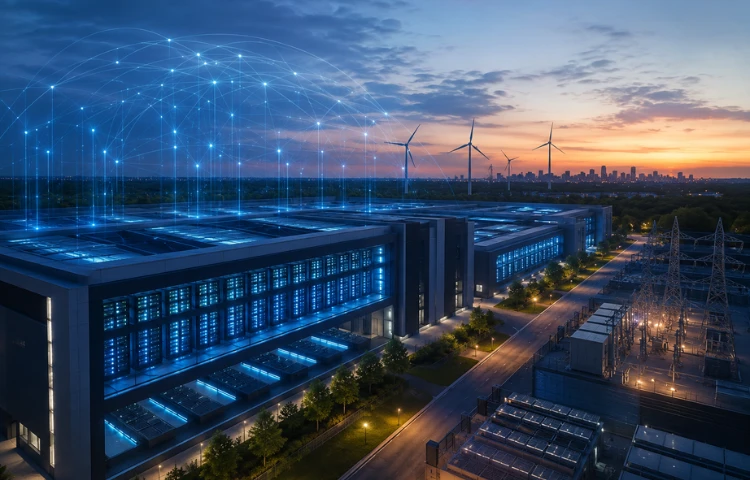
Applied Digital has signed a 15-year, $5.2 billion AI data center lease with an unnamed U.S.-based, investment-grade hyperscaler at its new Delta Forge 2 AI Factory campus. The agreement covers 210 megawatts of critical IT load under a take-or-pay lease structure, meaning the customer commits to paying for contracted capacity whether it fully uses it or not. With renewal options, the deal could reach approximately $12.7 billion over 30 years. Applied Digital says initial operations at Delta Forge 2 are expected to begin in Q1 2028.
That is not just a big number. It is a signal that AI infrastructure has moved from “cloud expansion” into a new era of industrial-scale compute real estate. Hyperscalers are no longer simply renting racks; they are locking down long-term, high-density campuses designed specifically for AI training and inference.
Why hyperscalers are racing for AI-ready capacity
AI models need a very different kind of infrastructure than traditional enterprise workloads. Training and running frontier-scale models require enormous power density, advanced cooling, resilient grid access, and enough physical space to support GPU-heavy clusters. Reuters noted that major technology companies are increasing data center spending to support powerful AI models, which is driving demand for electricity, computing capacity, and specialized facilities. [Reuters]
This is why Applied Digital’s deal matters. The company is not selling a generic data center; it is positioning Delta Forge 2 as a purpose-built AI Factory campus. Applied Digital says the campus will use its proprietary waterless cooling technology and high-power-density infrastructure, both designed for large-scale AI workloads.
For hyperscalers, the prize is certainty. AI demand is growing fast, but power availability, construction timelines, transformers, cooling systems, and permitting can all become bottlenecks. A long-term lease gives the customer a clearer runway for future AI deployment.
Delta Forge 2 is part of a bigger Applied Digital strategy
This $5.2 billion lease is not a one-off. Applied Digital says it is the company’s third long-term lease with the same U.S.-based investment-grade hyperscaler. The new agreement brings Applied Digital’s contracted portfolio to five AI Factory campuses, representing 1.4 gigawatts of critical IT load, about 2.15 gigawatts of grid-connected utility power, and approximately $36 billion in base-term contracted lease revenue. If renewal options are exercised, that figure could rise to about $86 billion.
This follows Applied Digital’s earlier $7.5 billion, 15-year lease at Delta Forge 1, which covered 300 megawatts of computing capacity at a 430-megawatt campus in the southern U.S.
The pattern is clear: Applied Digital is building a repeatable “AI Factory franchise” model. Instead of treating every data center as a custom mega-project, the company is trying to replicate a core design, construction, and operations playbook across multiple campuses.
The energy question: AI growth meets grid reality
The uncomfortable truth is that AI infrastructure growth is inseparable from electricity demand. The International Energy Agency estimates that global data center electricity consumption was about 415 terawatt-hours in 2024, or roughly 1.5% of global electricity consumption, and projects data center electricity demand could more than double to around 945 terawatt-hours by 2030.
In the U.S., power demand is already under pressure. Reuters reported that the U.S. Energy Information Administration expects U.S. power use to hit record highs in 2026 and 2027, with AI data centers among the drivers.
That makes Applied Digital’s waterless cooling claim especially relevant. Water consumption has become a major public concern around AI data centers, particularly in regions dealing with drought, rising electricity rates, or limited grid capacity. Cooling innovation can help, but it does not erase the broader need for transparent energy sourcing, grid coordination, and community engagement.
What this means for the AI market
The Applied Digital AI data center lease shows how the AI boom is reshaping the technology stack from the ground up. Chips and models get the headlines, but the real constraint may be infrastructure: land, power, cooling, financing, and time.
For investors, this deal highlights the growing value of companies that can deliver large-scale AI-ready capacity. For enterprises, it shows that AI adoption will increasingly depend on access to reliable compute. For policymakers, it raises urgent questions about energy planning, transparency, and responsible development.
The smartest view is not “AI data centers are good” or “AI data centers are bad.” It is this: AI infrastructure is becoming critical infrastructure. Deals like Applied Digital’s $5.2 billion lease will shape who can build advanced AI, where that AI runs, and how responsibly the industry scales.
Conclusion
Applied Digital’s $5.2 billion AI data center lease is more than a major real estate and infrastructure deal. It is a clear sign that the AI economy is entering its next phase: one defined by massive compute demand, long-term hyperscaler commitments, power availability, cooling innovation, and responsible infrastructure planning.
As enterprises race to adopt AI, the companies that can deliver scalable, energy-conscious, high-performance data center capacity will play a critical role in shaping the future of the industry. Applied Digital’s Delta Forge 2 campus shows how AI infrastructure is becoming just as important as the models, chips, and applications built on top of it.
The opportunity is enormous, but so is the responsibility. To earn public trust and support sustainable AI growth, data center operators must prioritize transparency, grid reliability, environmental impact, and real community value. In the years ahead, the winners in AI will not only be the companies building smarter systems. They will be the ones building the infrastructure to power them responsibly.