

Prefer to listen instead? Here’s the podcast version of this article.
Artificial intelligence is entering a new era. For years, AI has impressed us by generating text, creating images, and analyzing enormous amounts of information. Now, the next frontier is taking shape: intelligent machines capable of understanding, navigating, and interacting with the physical world.
That future took another step forward on October 14, 2026, when Chinese technology company Hesai Group officially launched Kosmo, a new 3D spatial data platform designed to accelerate the development of AI-powered robotics.
The launch marks a significant expansion for Hesai, which is widely recognized for its LiDAR technology used in autonomous vehicles.
According to [Reuters’ report on Hesai’s spatial camera launch] the company is targeting one of the biggest challenges in humanoid robotics: obtaining high-quality spatial data that enables robots to understand and interact with complicated real-world environments.
The announcement isn’t simply about a better camera. It is about building the digital infrastructure that robots need to learn how the physical world works.
Kosmo is a 3D world data engine that combines advanced sensing hardware with cloud-based AI technology.
The system consists of two core components: Kosmo One, a handheld spatial camera that captures detailed physical environments, and Kosmo World, a cloud platform that converts captured information into interactive 3D digital assets.
According to [Hesai’s official Kosmo launch announcement] the system is designed to make high-quality real-world spatial data more accessible for robotics developers, world-model researchers, and digital content creators.
Unlike conventional cameras, which primarily capture two-dimensional images, Kosmo One combines several technologies to capture the structure and appearance of physical environments.
Its sensing hardware incorporates high-resolution LiDAR, a one-inch imaging sensor, and an inertial measurement unit (IMU). Together, these components record geometry, color, texture, and camera position.
The device also supports 8K image capture, although Hesai specifies that the maximum resolution of exported files is 6K.
For readers unfamiliar with LiDAR, Hesai’s technical blog, [Understanding LiDAR: How 3D Perception Works and What It Can Do] explains how laser-based distance measurements create three-dimensional point clouds.
LiDAR helps machines measure where objects are located, while conventional cameras provide visual details such as colors, textures, and surface appearances.
By combining these capabilities, Kosmo can generate richer representations of real-world spaces.
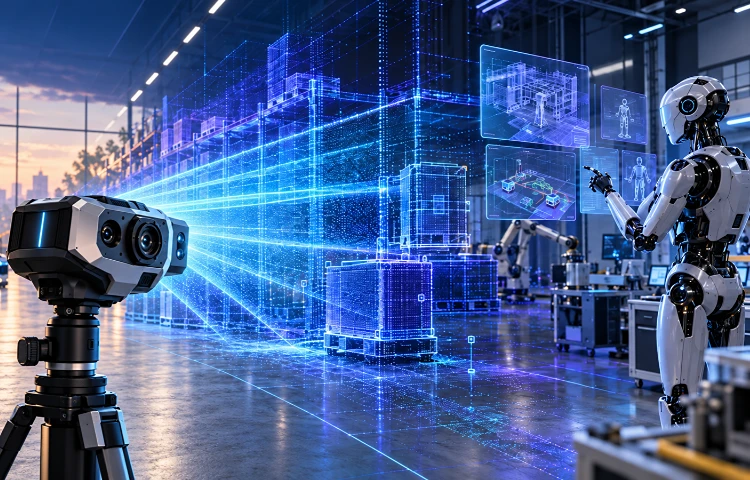
Imagine walking through a warehouse with the device and producing a detailed digital representation of its shelves, equipment, aisles, and surrounding structures.
That virtual environment could then become a training ground for intelligent robots.
One of the most significant aspects of Hesai’s launch is its attempt to address a persistent challenge in robotics development: the shortage of realistic training environments.
Robots cannot learn to operate reliably in complex settings through language-based instruction alone.
They must understand spatial relationships, recognize obstacles, navigate changing environments, and interact with objects safely.
Traditionally, creating realistic three-dimensional simulation environments has required extensive manual modeling, specialized equipment, and considerable engineering time.
Kosmo aims to simplify that process.
Kosmo World uses a technique known as 3D Gaussian Splatting (3DGS) to reconstruct detailed digital scenes from captured spatial information.
The technology represents visual environments using collections of three-dimensional elements that can reproduce realistic appearances from different viewing angles.
Kosmo World also generates mesh and depth data, enabling developers to work with more than a photorealistic visualization.
AI-assisted tools can identify individual objects, reconstruct missing visual information, and adapt the scene to the characteristics of a robot’s camera.
This approach could reduce the time needed to develop simulation environments for robotics research.
A detailed analysis published by [Unite.AI, Hesai Launches Kosmo to Turn Real-World Scans Into Robot Training Data] explains how the system combines spatial capture, cloud reconstruction, and simulation-ready data to support physical AI development.
The important advantage is reusability. Once an environment has been captured, developers may use it to train, test, and evaluate different robotic systems without reconstructing the entire physical space each time.
However, visual realism alone does not guarantee accurate physics. Developers still need appropriate collision models, material properties, and real-world validation before treating a reconstructed scene as a reliable simulation.
Speed is an important factor in the commercial adoption of robotics.
Developing a robot for a factory, warehouse, or retail environment can involve repeated cycles of data collection, simulation, testing, and refinement.
When creating training environments is expensive, innovation becomes slower.
Hesai claims Kosmo One can scan a typical 100-square-meter indoor environment in approximately 15 minutes.
The company also states that its reconstruction technology can generate certain 3D models up to five times faster than comparable products under similar conditions.
These are manufacturer-reported performance figures, and actual results will depend on environmental complexity, capture requirements, and computing resources.
Nevertheless, the potential impact is substantial.
Consider a logistics company planning to deploy autonomous robots across multiple warehouses.
Instead of manually building a separate simulation model for every location, its development team could potentially scan each facility and generate reusable digital environments.
Engineers could then test navigation routes, obstacle avoidance, object recognition, and workflow adjustments in simulation before deploying robots on-site.
The broader importance of this development becomes clear when examining [NVIDIA’s technical blog on building fast and reliable robot simulations with Omniverse]
NVIDIA explains how real-world reconstruction technologies, including Gaussian Splatting, can help transform sensor data into interactive robotics simulation environments.
Together, these developments point toward a future where realistic digital environments become essential infrastructure for physical AI.
The most compelling technology demonstrations often involve everyday tasks rather than futuristic laboratory experiments.
Hesai highlighted a deployment involving a Sharpa robot operating in a Dairy Queen ice cream store.
According to the company’s launch announcement, creating a 3D training environment for this deployment previously required approximately 300 hours of manual modeling.
Using Kosmo, the company reported completing scanning and reconstruction in just 15 minutes.
Hesai also stated that the robot achieved a 99% task success rate during the deployment, while its failure rate dropped to one-tenth of the previous level.
These figures are encouraging, although they represent a reported demonstration rather than proof that all AI-powered robots can achieve comparable performance.
The importance of the example lies in what it illustrates.
A robot operating in a commercial setting must perform multiple tasks that require visual understanding, spatial reasoning, and physical coordination.
It must recognize its working environment, move accurately, manipulate objects, and respond to changes.
A realistic digital representation of that environment may allow developers to improve performance before exposing the robot to unpredictable real-world conditions.
This is one reason physical AI is attracting growing attention across the technology sector.
Hesai’s launch is part of a much larger trend: the development of AI systems that can understand the physical world rather than simply process digital information.
These systems are often described using terms such as spatial AI, embodied AI, physical AI, and world models.
Although the concepts overlap, they address different aspects of intelligent machine behavior.
Spatial AI focuses on understanding three-dimensional environments and relationships between objects.
Embodied AI explores how intelligence operates through physical systems such as robots.
World models aim to represent environments and potentially predict how they change when actions occur.
Kosmo contributes to this ecosystem by providing real-world spatial data and reconstructed environments that developers can use when building and evaluating intelligent systems.
A robot may recognize an object without knowing exactly how to approach or manipulate it.
For example, recognizing a cup is different from understanding where its handle is located, identifying a safe grasping position, and moving it without spilling the contents.
That requires multiple capabilities working together.
Google DeepMind’s blog [Gemini Robotics Brings AI Into the Physical World] explores how vision-language-action models and spatial reasoning help robots understand instructions and translate them into physical actions.
Google DeepMind’s work focuses on robotic intelligence and control, while Hesai’s Kosmo system focuses primarily on capturing and reconstructing environments.
These technologies are complementary rather than interchangeable.
A robot needs both an intelligent system capable of deciding what to do and reliable information about the world in which it operates.
Although humanoid robotics is receiving considerable attention, the commercial opportunities for spatial data technology extend far beyond human-shaped machines.
Factories operate in complicated environments where equipment, materials, and production layouts can change.
Accurate 3D models could help businesses simulate robotic workflows, optimize production layouts, and evaluate automated systems before making costly physical modifications.
By digitizing factory environments, manufacturers may be able to identify potential problems earlier and reduce the complexity of introducing new robotic equipment.
Warehouse automation depends heavily on spatial awareness.
Autonomous mobile robots need to understand aisles, shelving systems, obstacles, and working zones.
Detailed digital environments could support the development and testing of navigation systems, allowing businesses to experiment with different warehouse configurations and robotic workflows.
The Dairy Queen demonstration illustrates the potential for robots to assist with routine service operations.
Spatial training environments could support robotics applications in stores, restaurants, hospitality environments, and customer-facing facilities.
However, businesses must evaluate reliability, maintenance requirements, customer safety, and operational costs before introducing such systems at scale.
Kosmo is not limited to robotics.
Hesai has demonstrated applications involving Pixar’s RenderMan and the Amap mapping platform.
The system could help filmmakers capture physical locations for virtual production, assist developers in creating realistic digital environments, and enable businesses to develop interactive 3D representations of physical spaces.
These applications illustrate how investments in physical AI infrastructure may generate value across several industries.
Hesai’s expansion into spatial intelligence represents an important strategic shift.
The company has built its reputation around LiDAR sensing technology for autonomous vehicles.
With Kosmo, Hesai is moving beyond supplying sensors toward offering a broader platform for collecting, processing, and managing spatial data.
The company’s strategy includes robotic sensing, 3D reconstruction software, cloud services, and robotic actuation hardware.
At the October 2026 launch, Hesai also announced partnerships with embodied AI companies Galbot and Dexmal.
These collaborations suggest that Hesai intends to position itself within the broader robotics development ecosystem rather than rely exclusively on automotive customers.
An additional component of the company’s strategy is the ability to generate training trajectories from captured environments.
Hesai reports that one scanned environment can support the automatic generation of more than 10,000 training trajectories, with data acquisition efficiency potentially exceeding 100 times that of certain conventional approaches at comparable cost.
These estimates have not established a universal benchmark across robotics tasks, but they highlight the company’s emphasis on scalable data production.
For developers, the value proposition is clear: more realistic training data could help reduce the cost and effort required to develop robotic applications.
The long-term commercial success of Kosmo will depend on whether these capabilities translate into reliable, affordable, and repeatable results for customers.
Hesai’s Kosmo spatial camera highlights a fundamental change in artificial intelligence.
The industry is moving toward systems that must understand physical environments, predict outcomes, and take meaningful action.
For robotics developers, access to detailed 3D spatial data could accelerate experimentation and reduce the effort required to prepare training environments.
For businesses, the technology could support more effective planning for automation in manufacturing, logistics, retail, and other industries.
For the broader AI ecosystem, the launch demonstrates that innovation is increasingly happening at the intersection of hardware, simulation software, machine learning, and real-world data.
However, significant challenges remain.
Reliable robot behavior still requires accurate simulation, robust perception, safe physical control, and careful testing.
Kosmo addresses an important part of that development process, but it is not a complete solution to every robotics challenge.
China’s Hesai launching the Kosmo spatial camera marks a significant step forward in the evolution of AI-powered robotics, spatial intelligence, and physical AI. By combining advanced LiDAR technology, high-resolution imaging, and AI-driven 3D reconstruction, Hesai aims to bridge the gap between digital simulations and real-world robotic applications.
The technology has the potential to transform industries such as manufacturing, logistics, retail, and autonomous systems by making realistic robot training environments easier and faster to create. As companies increasingly invest in intelligent automation, solutions like Kosmo could help accelerate robotics development, reduce training complexity, and improve operational efficiency.
However, widespread adoption will depend on overcoming challenges related to implementation costs, data privacy, simulation accuracy, and robotic safety. Businesses must balance technological innovation with responsible AI development to ensure reliable and scalable deployment.
The future of AI is no longer just about machines that can think—it’s about machines that can understand, navigate, and interact with the physical world. Hesai’s spatial camera represents an important development toward that future, where robotics and artificial intelligence work together to reshape everyday business operations.










WEBINAR

