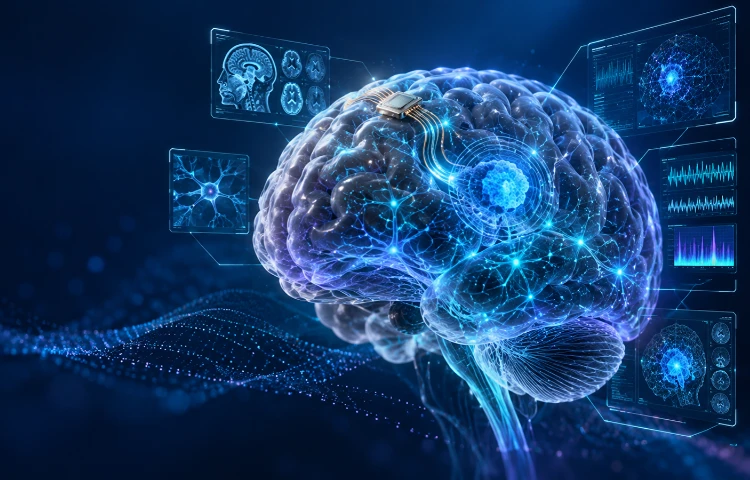
Artificial intelligence is moving beyond chatbots, digital assistants, and automated workflows. Its next frontier could be inside the human brain.
In a development that brings together neuroscience, artificial intelligence, and cancer research, OpenAI’s venture capital arm has invested in Coherence Neuro, a startup developing brain implants designed to detect and potentially treat brain cancer.
The investment is part of a $45 million seed funding round that also includes Peter Thiel’s Founders Fund. It reflects growing interest among major technology investors in brain-computer interfaces (BCIs) and the possibility of using AI to understand complex biological signals.
According to [WIRED] the startup is developing a device that could monitor electrical signals associated with brain tumors and eventually deliver targeted electrical stimulation intended to slow tumor growth.
Although the technology remains experimental, its potential is significant. Instead of relying exclusively on periodic medical imaging, future brain implants might help doctors continuously monitor changes in tumor activity.
The bigger story is not simply that OpenAI has invested in another startup. It is that AI companies are increasingly exploring how advanced computing could contribute to medical discovery, personalized treatment, and the future of healthcare.
What Is Coherence Neuro, and Why Is OpenAI Investing?
Coherence Neuro is a San Francisco-based neurotechnology startup co-founded by CEO Ben Woodington. The company is developing implantable technology that combines neural signal recording, artificial intelligence, and electrical stimulation.
Its ambition is to make brain cancer monitoring more continuous and potentially more responsive to changes in a patient’s condition.
Unlike traditional brain-computer interfaces, which are often developed to help people with paralysis communicate or control digital devices, Coherence Neuro is exploring an application focused on cancer.
The company’s technology is intended to recognize electrical patterns associated with tumor activity and use those signals to help guide treatment decisions.
This approach has attracted major investors, including OpenAI’s Startup Fund and Founders Fund.
However, an important distinction is that the $45 million represents the startup’s overall reported seed funding round, not the amount invested by OpenAI alone. The individual investment amount has not been publicly detailed in the reporting.
For OpenAI, the investment fits a broader strategic interest in applying sophisticated AI models to scientific and biological problems.
How Could AI-Powered Brain Implants Detect Cancer?
The technology behind Coherence Neuro combines neuroscience with machine learning.
The human brain communicates through electrical and chemical activity. Researchers have also discovered that some brain tumors interact with surrounding neurons in ways that can support cancer growth.
Coherence Neuro aims to investigate whether those interactions can provide useful information about tumor progression.
The proposed system involves three interconnected processes.
1. Recording Electrical Signals From Brain Tissue
The startup is developing a small implant intended to record electrical activity from tissue near a brain tumor.
Unlike conventional magnetic resonance imaging (MRI), which provides images of brain anatomy at particular moments, an implanted sensor could potentially gather physiological information over extended periods.
This might help clinicians identify changes occurring between scheduled scans.
2. Using Artificial Intelligence to Interpret Tumor Activity
Brain recordings can contain enormous quantities of complicated, overlapping signals.
Machine learning could help researchers identify patterns associated with tumor growth, treatment response, or recurrence.
According to Coherence Neuro’s reported animal research, the company has developed methods for detecting signals associated with changes in tumor activity.
However, translating these observations into a clinically reliable human cancer-detection system remains an important challenge.
Researchers must demonstrate that AI models can distinguish meaningful cancer-related changes from ordinary brain activity, noise, and other biological variations.
3. Delivering Targeted Electrical Stimulation
Coherence Neuro is also investigating whether its implant could deliver mild electrical stimulation intended to interfere with tumor growth.
The long-term goal is a system that combines monitoring and intervention, potentially adjusting stimulation based on recorded signals.
This type of technology is sometimes described as a closed-loop therapeutic system, because sensor information can feed back into treatment decisions.
The concept is promising, but there is currently insufficient human clinical evidence to conclude that Coherence Neuro’s implant can prevent tumor growth or improve survival.
What Have Human Trials Revealed So Far?
Coherence Neuro has already completed limited early human testing of its implant’s recording capabilities.
As detailed in [WIRED] the company temporarily tested its coin-sized device in three patients undergoing brain tumor removal surgery at Royal Melbourne Hospital in Australia.
The implants remained in place for approximately 30 minutes before being removed.
These procedures represented an early opportunity to evaluate device recording and safety characteristics in a surgical setting.
According to the October 2026 reporting, additional testing involving seven patients is examining recording and stimulation capabilities.
The company also intends to pursue clinical trials involving longer-term implantation in patients with glioblastoma.
Importantly, these developments do not mean the implant has been clinically proven to diagnose or treat brain cancer.
A brief intraoperative test is fundamentally different from demonstrating that a permanently implanted medical device can safely monitor tumors over months or years.
Before a technology like this can become part of routine cancer treatment, clinical research will need to answer several questions:
- Can the implant reliably distinguish tumor-related signals from other brain activity?
- Can it identify recurrence earlier than existing monitoring methods?
- Does electrical stimulation meaningfully improve patient outcomes?
- Can the implant remain safe and functional over extended periods?
- How does its performance compare with established treatments and diagnostic tools?
These questions will determine whether the approach becomes a meaningful clinical advancement or remains a promising experimental concept.
OpenAI’s Growing Interest in Brain-Computer Interfaces
Coherence Neuro is not OpenAI’s only investment connected to brain-computer interface technology.
In January 2026, OpenAI announced its participation in the seed funding round for Merge Labs, a neurotechnology company whose co-founders include Sam Altman in a personal capacity.
In [OpenAI’s official blog post, “Investing in Merge Labs”] the company described brain-computer interfaces as an important frontier for connecting biological intelligence with advanced computing systems.
Merge Labs is exploring approaches that include ultrasound-based brain interfaces, while Coherence Neuro focuses on recording electrical signals associated with tumors and investigating therapeutic stimulation.
These are different technical approaches, but both illustrate why AI companies are increasingly interested in complex neural data.
Researchers believe that sophisticated machine-learning models could eventually help interpret biological signals that are too complicated for conventional analytical methods.
At the same time, these ambitious projects face scientific limitations.
A [Nature explainer examining the science behind OpenAI-backed Merge Labs] highlights how emerging brain-interface technologies remain at an early stage, with important technical questions still unresolved.
The broader lesson is that investment in neuroscience does not automatically translate into clinically effective technology.
Progress requires rigorous experimentation, reproducible results, and independent scientific evaluation.
Could Brain Implants Change the Future of Cancer Treatment?
One of the potential advantages of continuous brain monitoring is the ability to observe changes in a patient’s condition between hospital appointments.
For patients with aggressive brain tumors, treatment decisions frequently depend on imaging, medical examinations, and other clinical evidence.
A future implantable monitoring system might complement those methods by providing additional physiological information.
For example, researchers could investigate whether unusual electrical patterns predict tumor recurrence, changes in disease activity, or responses to therapy.
Such information might help physicians make more informed decisions about follow-up testing and treatment adjustments.
Another potential advantage is personalization.
Different tumors may respond differently to treatment. AI systems that analyze longitudinal patient data could potentially help clinicians recognize those differences and investigate more individualized approaches.
However, these possibilities are not yet established benefits of Coherence Neuro’s device.
Any successful cancer-monitoring implant would need to demonstrate accuracy, reliability, patient safety, and meaningful clinical outcomes.
AI should support medical expertise rather than replace professional clinical judgment.
The Ethical and Regulatory Challenges of AI Brain Implants
While the possibilities are exciting, brain implants introduce important ethical, regulatory, and technical considerations.
Patient Privacy and Sensitive Neural Data
Brain activity and health information are exceptionally sensitive.
Organizations developing implantable AI medical technologies must establish clear rules around consent, data collection, access, retention, cybersecurity, and potential secondary use of information.
In its October 2026 reporting, WIRED quoted Coherence Neuro’s CEO as saying that its arrangements with OpenAI do not provide the AI company access to the startup’s brain or health data.
That distinction matters, but it does not eliminate the need for strong independent data governance.
Clinical Safety and Regulatory Approval
Brain implantation is an invasive medical procedure.
Potential risks include infection, bleeding, tissue injury, device malfunction, and complications associated with long-term implantation.
Any device intended for ongoing clinical use must undergo appropriate testing and regulatory assessment.
Regulators must also consider how machine-learning systems are developed, validated, monitored, and updated after deployment.
Algorithmic Reliability and Medical Accountability
An incorrect AI interpretation could lead to an unnecessary medical intervention or a delay in treatment.
Developers must demonstrate that systems perform reliably across different patients, tumor characteristics, and clinical conditions.
Transparent reporting, clinician oversight, and independent evaluation are therefore essential.
What Does This Mean for Healthcare Companies and Technology Leaders?
OpenAI’s investment in Coherence Neuro offers several insights for organizations monitoring the future of healthcare innovation.
First, AI’s value increasingly depends on the quality of specialized data. Neurotechnology illustrates how advances in sensors, hardware, and machine learning can create opportunities that software alone cannot provide.
Second, medical AI innovation requires collaboration across multiple disciplines. Neuroscientists, oncologists, clinicians, engineers, machine-learning researchers, and regulatory specialists must work together to turn experimental systems into clinically useful tools.
Third, responsible development is becoming a competitive necessity. A technically impressive AI model will have limited medical value if it cannot demonstrate reliable performance, secure sensitive patient information, and integrate effectively into healthcare workflows.
Finally, organizations should distinguish between technological feasibility and real-world clinical benefit.
Early research results and investment announcements can identify promising directions, but validated patient outcomes are the true measure of healthcare progress.
Conclusion: OpenAI’s Brain Implant Investment Signals a New Direction for Medical AI
OpenAI’s investment in Coherence Neuro is another sign that artificial intelligence is expanding into areas where computational research meets human biology.
The startup’s ambition is particularly significant: developing brain implants that can monitor electrical signals associated with cancer and potentially use those signals to guide targeted treatment.
If future studies demonstrate safety and meaningful clinical effectiveness, such technology could contribute to more continuous monitoring, better-informed treatment decisions, and new avenues of cancer research.
But the distinction between potential and proven benefit remains essential.
The technology is still experimental, and major scientific, clinical, and regulatory challenges must be addressed before it can become part of routine patient care.
For healthcare innovators, technology companies, and researchers, the development highlights an important trend: the future of AI in healthcare may depend not only on smarter algorithms but also on entirely new ways of understanding biological systems.